
Topic Battle

Where Everything Fights Everything

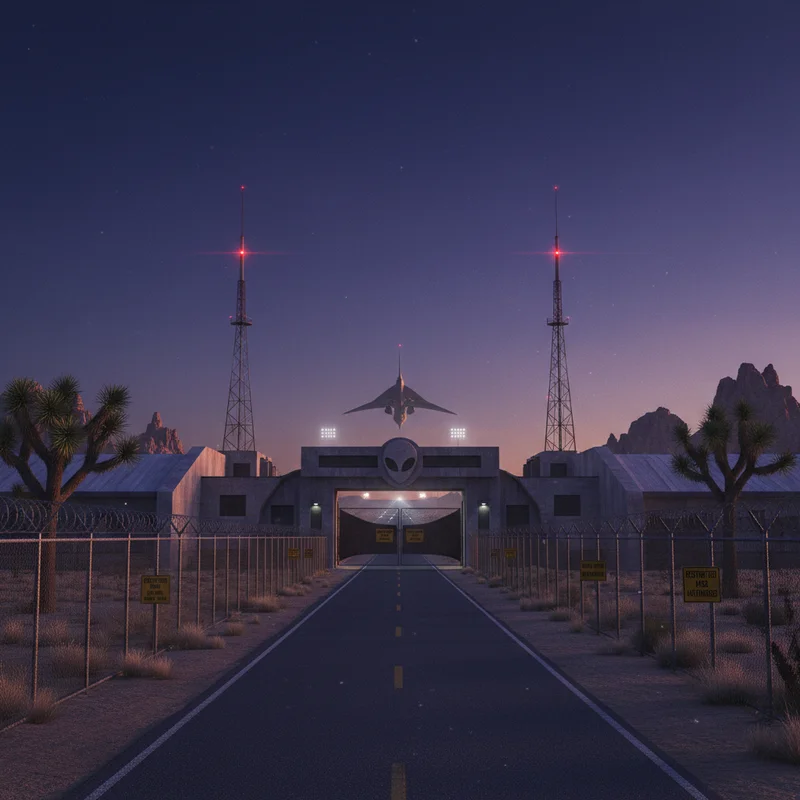
Area 51

Area 51

US military base and alien conspiracy hotspot.

VS
Social Media

Social Media

Digital platforms connecting and dividing humanity simultaneously.

Battle Analysis

Accessibility Social Media Wins
30%
70%
Area 51 Social Media

Area 51

The installation maintains what military strategists term "absolute denial of access." Armed guards, motion sensors, and the explicit authorisation to use lethal force create a barrier that has proven impermeable to civilian approach. The nearest public vantage point lies 26 miles from the primary facilities. Curious visitors must content themselves with photographing warning signs and purchasing alien-themed merchandise from the nearby town of Rachel, population 54. The inaccessibility is not a bug; it is the facility's defining feature.

Social Media

The platforms have achieved what anthropologists term "frictionless integration" into daily existence. Access requires merely an internet connection and a willingness to accept terms of service that no human has ever read in their entirety. Smartphone penetration ensures that 6.4 billion devices offer instant portal access. The average user encounters their first social media interface at age 10 and spends 2.5 hours daily within platform boundaries thereafter. The accessibility borders on the involuntary.

VERDICT

Social media removes all barriers whilst Area 51 exists primarily to maintain them.
Stress impact Area 51 Wins
70%
30%
Area 51 Social Media

Area 51

For the overwhelming majority of humanity, Area 51 generates minimal direct stress. Its existence provides a pleasant frisson of mystery, a conversational topic for dinner parties, and occasional entertainment through documentary programming. The exception proves instructive: personnel stationed at the facility report elevated cortisol levels, presumably from the burden of secrets rather than extraterrestrial contact. For civilians, Area 51 represents aspirational stress—the tantalising anxiety of not knowing rather than the grinding pressure of constant engagement.

Social Media

Clinical research has established a robust correlation between platform usage and psychological distress. Studies document a 30% increase in anxiety symptoms among heavy users, with particularly pronounced effects in adolescent populations. The mechanisms are multiple: social comparison dynamics, fear of missing out, algorithmic amplification of outrage, and the peculiar stress of maintaining a curated digital identity. The platforms have achieved what decades of Cold War tensions could not: ubiquitous, low-grade anxiety distributed across the entire connected population.

VERDICT

Area 51 offers the pleasant stress of mystery; social media delivers the corrosive stress of comparison.
Meme potential Social Media Wins
30%
70%
Area 51 Social Media

Area 51

The facility reached its memetic apex during the 2019 "Storm Area 51" phenomenon, wherein 2.1 million Facebook users pledged to overwhelm military security through sheer numerical enthusiasm. This event generated approximately 4.3 million original meme variations, from Naruto running tutorials to alien liberation strategems. The imagery of classified hangars and desert landscapes provides endless template possibilities, though the source material remains frustratingly static. One can only generate so many variations on "what's inside" before the format exhausts itself.

Social Media

As the primary distribution mechanism for global meme culture, social media occupies a unique position in memetic ecology. It is simultaneously the subject of memes and the substrate upon which all memes exist. The platforms generate approximately 500,000 meme templates daily, with content depreciation occurring at unprecedented velocity. A meme format achieves saturation within 72 hours and obsolescence within a fortnight. Social media has not merely high meme potential; it has become the very definition of meme potential itself.

VERDICT

One cannot separate social media from meme culture; they have become synonymous phenomena.
Global recognition Social Media Wins
30%
70%
Area 51 Social Media

Area 51

The Nevada installation achieved worldwide recognition through decades of careful government denial and enthusiastic Hollywood embellishment. Surveys indicate that approximately 94% of adults in Western nations can identify Area 51 by name, though fewer than 0.003% could locate it on an unmarked map. The facility's silhouette has appeared in over 400 feature films and 12,000 television episodes, establishing it as perhaps the most famous restricted zone in human history. Its very obscurity has become its greatest publicity asset.

Social Media

The digital platforms have achieved a penetration rate that Area 51's most optimistic proponents could scarcely imagine for extraterrestrial contact. With 4.9 billion active users representing 62% of the global population, social media has transcended mere recognition to become a fundamental infrastructure of modern communication. In certain demographics, the question is not whether one recognises social media, but whether one has experienced a waking moment without its influence. The recognition is not merely global; it is totalising.

VERDICT

Social media has achieved the recognition that Area 51 can only dream of through its classified exclusivity.
Historical significance Social Media Wins
30%
70%
Area 51 Social Media

Area 51

Established in 1955 as a testing ground for the U-2 reconnaissance aircraft, the facility has served as the proving ground for humanity's most advanced aviation technology. The SR-71 Blackbird, F-117 Nighthawk, and countless classified programmes developed within its boundaries. Its role in Cold War intelligence gathering arguably prevented thermonuclear conflict through the principle of verified capability. Beyond the rumours of alien technology lies a genuine history of human ingenuity pushing the boundaries of atmospheric flight.

Social Media

Emerging in the early 2000s, the platforms have compressed revolutionary societal change into a mere two decades. Facebook's founding in 2004 preceded the reshaping of political campaigns, the transformation of journalism, the redefinition of human relationships, and the creation of entirely new categories of celebrity. Historians increasingly identify 2007—the year of the iPhone's release—as the dividing line between epochs. The historical significance is not retrospective; it is actively accumulating at exponential rates.

VERDICT

Area 51 shaped the Cold War; social media is actively reshaping the entire human experience.
👑

The Winner Is

Social Media

42 - 58

The comparison between these two monuments to modern mystery reveals a fundamental truth about human attention: we are drawn to that which we cannot fully understand, whether classified by government decree or algorithmic opacity. Area 51 maintains its allure through the romance of the restricted, whilst social media commands engagement through the psychology of the accessible.

Yet the metrics speak with unavoidable clarity. Social media has achieved a scope of influence that transcends the physical limitations of a desert installation. It has inserted itself into the fabric of daily existence in a manner that even the most enthusiastic alien theorist could not claim for their favoured conspiracy. The platforms have won not through secrecy but through ubiquity.

Area 51
42%
Social Media
58%

Share this battle

More Comparisons