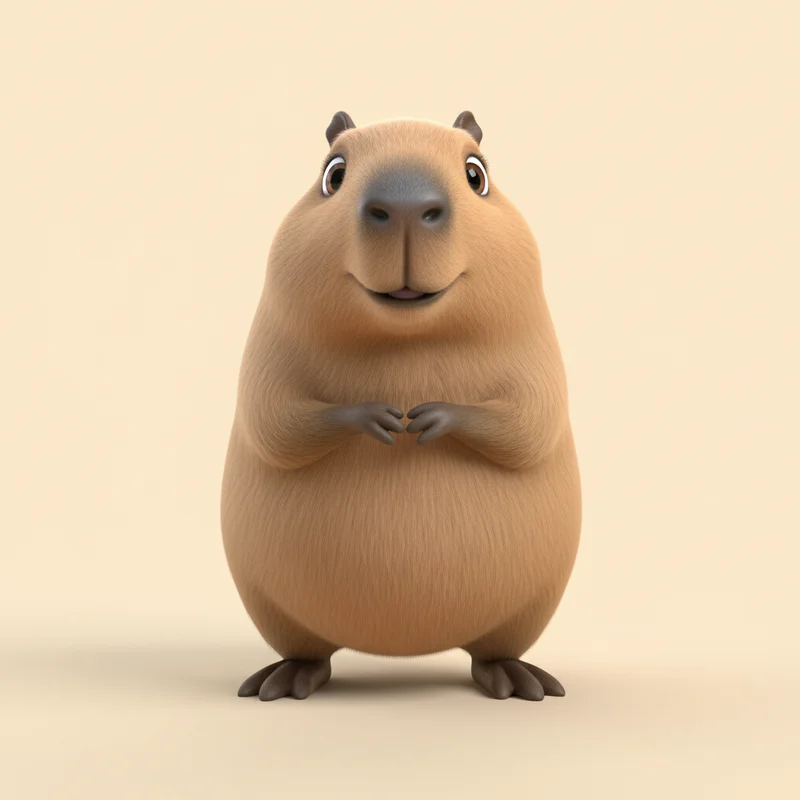

Capybara
Individual capybaras achieve lifespans of 8-12 years in the wild, extending to 12-15 years under protected conditions. This modest individual durability belies the species' remarkable evolutionary persistence. The capybara lineage extends back approximately 8 million years, with the genus maintaining its essential characteristics throughout this period.
The species has demonstrated exceptional adaptability to environmental change. Capybaras have successfully colonised urban environments in parts of South America, appearing in parks, golf courses, and residential areas with characteristic indifference to human proximity. Their semi-aquatic adaptations provide resilience against both terrestrial and aquatic predation pressures.
Furthermore, the capybara's reproductive efficiency ensures population stability. Females produce litters of 4-8 offspring annually, with minimal parental investment required beyond initial nursing. The species approaches what ecologists term sustainable abundance.
Football
A regulation football demonstrates functional durability of approximately 2-5 years under regular use, though professional matches employ new balls to ensure consistent performance characteristics. The object itself represents relatively disposable technology, easily manufactured and replaced.
However, the conceptual durability of football proves remarkable. The sport's rules have remained fundamentally stable since 1863, when the Football Association codified them in London. The basic premise, kicking a ball between posts, has persisted essentially unchanged for over 160 years, whilst incorporating only minor modifications.
Football as an institution has survived world wars, pandemics, and technological revolutions without significant disruption. The sport continued during the 1918 influenza pandemic, adapted to television broadcasting, and has navigated the digital age with viewership growth rather than decline. This institutional durability exceeds any individual object's lifespan.