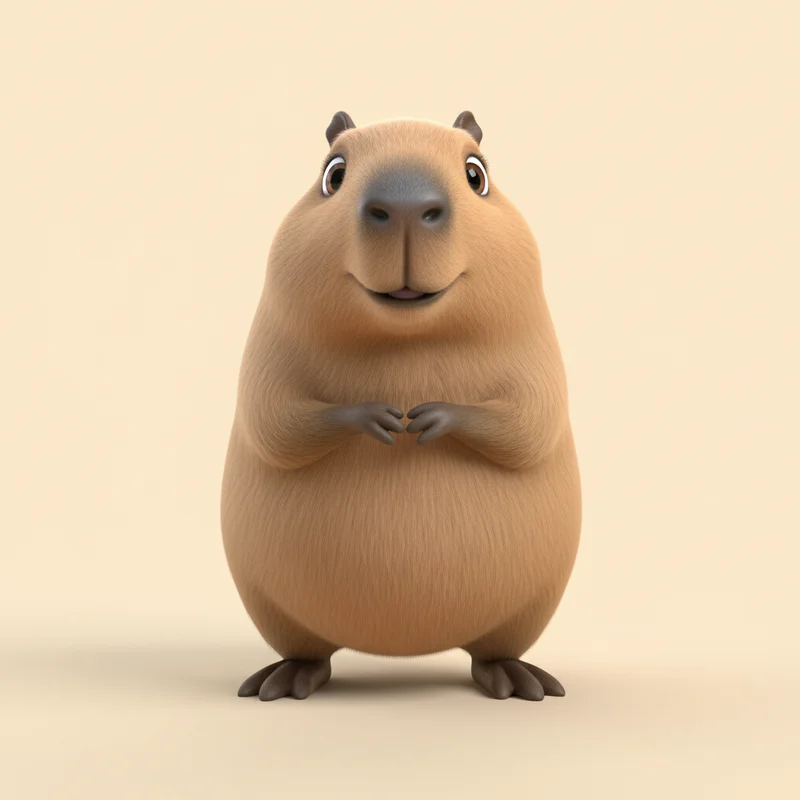

Capybara
The capybara demonstrates impressive biological resilience within its natural habitat parameters. Wild capybaras achieve lifespans of 8 to 10 years, while captive specimens under optimal conditions have reached 12 years. Throughout this period, the capybara self-repairs minor injuries, regenerates damaged tissue, and maintains operational functionality through a sophisticated immune system refined over millions of years of evolutionary pressure.
However, the capybara's durability comes with significant maintenance requirements. The creature must consume approximately 3 kilograms of vegetation daily to maintain structural integrity. It requires access to water for thermoregulation, social companions for psychological stability, and protection from predators including jaguars, anacondas, and, historically, humans. Without these inputs, the capybara's operational lifespan decreases dramatically.
The capybara is also subject to entropy in ways the rubber duck is not. Its teeth grow continuously at 0.3 millimeters per day and must be worn down through gnawing; failure to do so results in dental malocclusion. Its skin requires regular moisturizing through water immersion. Its social bonds must be constantly maintained. The capybara is, in engineering terms, a high-maintenance system.
Rubber Duck
The rubber duck achieves durability through the radical elimination of biological processes. Manufactured from polyvinyl chloride (PVC), modern rubber ducks exhibit resistance to water damage, ultraviolet radiation, and temperature fluctuations within the range of -20 to 60 degrees Celsius. They do not age in the biological sense, do not require nutrition, and do not experience the cellular degradation that limits organic lifespan.
Laboratory testing has demonstrated that quality rubber ducks maintain structural and functional integrity through 100,000+ submersion cycles without measurable degradation. The limiting factors in rubber duck longevity are typically external forces: dog attacks, vacuum cleaner accidents, and deliberate disposal. Left undisturbed, a rubber duck will outlast the bathroom fixtures surrounding it.
Documented cases exist of rubber ducks remaining functional for over 50 years. The famous "Friendly Floatees" incident of 1992, in which approximately 28,800 rubber ducks were lost from a cargo ship in the Pacific Ocean, produced specimens that washed ashore decades later in remarkably good condition. Some are believed to still be floating today, having survived encounters with sea ice, marine predators, and the world's major ocean currents.
VERDICT
Durability comparison reveals the fundamental distinction between biological and manufactured products. The capybara represents extraordinary evolutionary engineering, capable of self-repair and adaptation that no rubber duck can match. However, this sophistication introduces failure modes unknown to simpler systems.
The rubber duck's durability advantage stems from the absence of life rather than the presence of superior materials. A capybara can heal a wound; a rubber duck will never sustain one. A capybara will inevitably die; a rubber duck simply waits. In the category of pure temporal persistence, the rubber duck achieves victory through immortality.