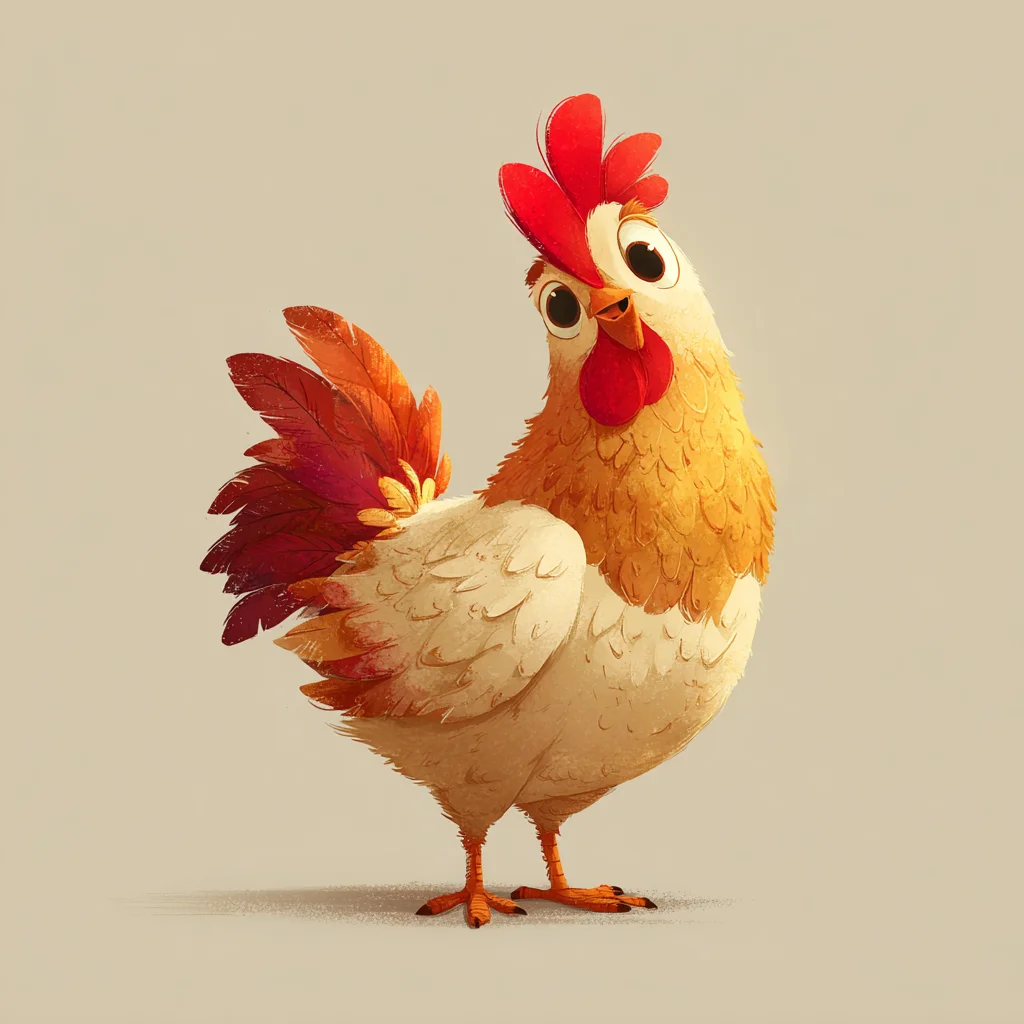

Chicken
The chicken maintains a production schedule of extraordinary consistency. Commercial laying hens produce between 250 and 300 eggs annually, with heritage breeds averaging somewhat fewer but maintaining reliable output across productive lifespans of five to seven years. This represents a biological contract executed with almost contractual precision.
Dawn awakening occurs with atomic-clock reliability, triggered by photoreceptors sensitive to the earliest light frequencies. The rooster's crow commences approximately two hours before sunrise, regardless of whether anyone has requested this service. Complaints have been lodged; they remain unacknowledged.
The foraging routine proceeds with methodical thoroughness. A chicken processes approximately one hectare of ground during active feeding periods, systematically eliminating insects, seeds, and small invertebrates according to a pattern that suggests neither indecision nor the sudden need to check whether any interesting seeds have appeared elsewhere.
Procrastination
Procrastination demonstrates remarkable unreliability by design. Indeed, unreliability constitutes its defining characteristic. Tasks scheduled for completion by Tuesday arrive on Thursday, if at all. Deadlines function not as targets but as suggestions, to be renegotiated upon approach.
The procrastinator's daily schedule exists in a state of perpetual renegotiation. Activities planned for morning migrate to afternoon, then evening, then "first thing tomorrow, absolutely definitely." Research indicates that approximately 20% of adults identify as chronic procrastinators, though the actual figure may be higher among those who haven't got around to completing the survey.
Output reliability approaches zero predictability. Some tasks are eventually completed in frantic bursts of deadline-adjacent activity. Others enter a permanent holding pattern, orbiting the to-do list like satellites that have forgotten their original mission. The procrastinator maintains optimism throughout: tomorrow represents infinite possibility.
VERDICT
The reliability differential between these subjects approaches categorical incompatibility. One subject produces measurable output on a predictable schedule; the other has made unpredictability into a lifestyle philosophy.
The chicken requires no external motivation, accountability systems, or browser extensions that block access to distracting websites. It simply proceeds with chicken activities according to an internal programme refined across 10,000 years of domestication.
Procrastination, by contrast, has spawned an entire industry dedicated to its management. The existence of "productivity coaches" and "time-blocking methodologies" suggests a fundamental reliability deficit requiring continuous professional intervention.