
Topic Battle

Where Everything Fights Everything

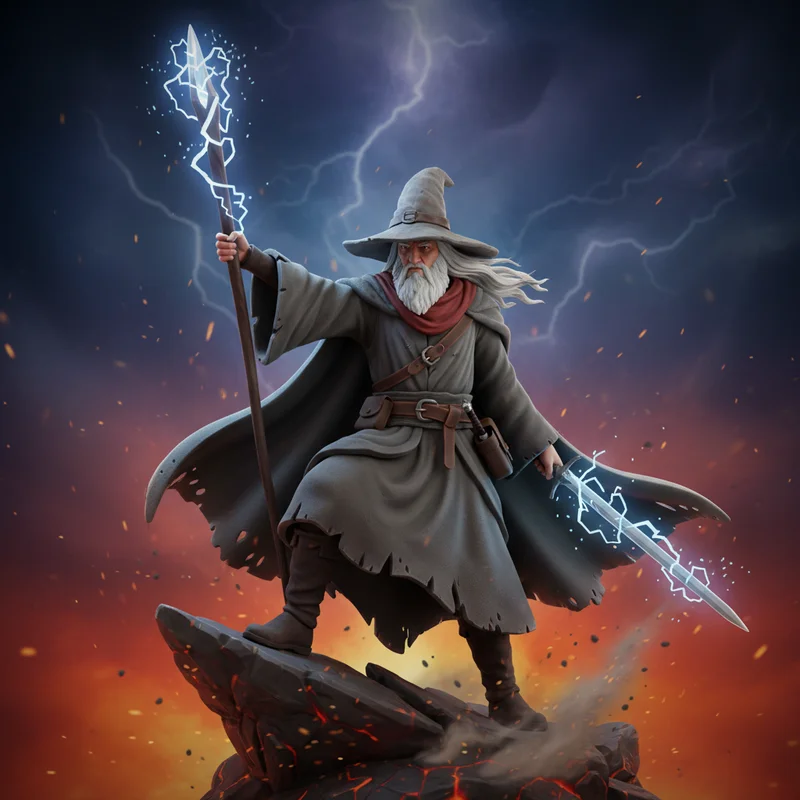
Gandalf

Gandalf

Wizard who is never late or early.

VS
Money

Money

Abstract concept that runs the world.

Battle Analysis

Corruption resistance Gandalf Wins
70%
30%
Gandalf Money

Gandalf

Gandalf's resistance to corruption stands as his defining characteristic. When offered the One Ringโ€”an artefact of essentially unlimited powerโ€”he refused instantly, recognising that even his considerable virtue would eventually succumb to its influence. This self-awareness regarding corruption's insidious nature demonstrates wisdom beyond mere power. Throughout his existence, Gandalf has never been bribed, blackmailed, or compromised. His values remain immutable constants in a universe of moral flexibility, anchored by his fundamental nature as a servant of the Valar.

Money

Money serves as the primary vector of corruption in human civilisation. Studies suggest that $2.6 trillion is lost annually to corruption globally, with money serving as both motive and mechanism. The mere presence of money alters human behaviour, with research indicating that even handling currency increases antisocial tendencies. Bribes, embezzlement, and financial fraud represent money's natural expression when human ethics falter. Money does not merely fail to resist corruption; it actively enables and amplifies it.

VERDICT

Gandalf refuses ultimate power on principle; money enables humanity's basest instincts at industrial scale.
Transformative influence Money Wins
30%
70%
Gandalf Money

Gandalf

The wizard's interventions, whilst strategically precise, affect relatively contained geographical areas. His guidance of Bilbo led to Smaug's defeat, liberating the Lonely Mountain's estimated 15 million gold coins. His counsel to Frodo saved Middle-earth entirely. Yet these remain singular, albeit spectacular, transformations. Gandalf operates through individuals, creating ripples rather than tides. His methodology prioritises quality of intervention over quantity, favouring the well-placed word over the grand gesture.

Money

Money's transformative power operates on an entirely different scale. The 2008 financial crisis affected approximately 2.6 billion people, demonstrating money's capacity for simultaneous global transformation. Currency fluctuations can elevate or devastate entire nations overnight. The mere promise of money has launched colonial expeditions, funded scientific revolutions, and reshaped the physical geography of continents through infrastructure development. Money transforms everything it touches, for better or considerably worse.

VERDICT

Whilst Gandalf saves worlds, money reshapes them continuously across all seven continents simultaneously.
Longevity and persistence Gandalf Wins
70%
30%
Gandalf Money

Gandalf

Gandalf's existence spans countless millennia, having been present at the creation of Arda itself as one of the Ainur. His physical manifestation in Middle-earth lasted approximately 2,019 years, during which he neither aged in the conventional sense nor succumbed to the ailments that plague mortal beings. Even apparent death proved merely a temporary inconvenience, as his transformation from Grey to White demonstrated a remarkable capacity for supernatural persistence. His memory alone contains the complete history of multiple ages.

Money

The concept of currency has persisted for roughly 5,000 years, evolving from Mesopotamian grain receipts through Lydian coins to modern cryptocurrency. Individual currencies, however, demonstrate alarming mortality rates. The average lifespan of a fiat currency is merely 27 years, with the British pound sterling being a notable exception at over 300 years. Inflation, governmental collapse, and economic catastrophe have consigned countless monetary systems to the dustbin of history. Money endures as a concept; specific monies rarely do.

VERDICT

Immortal beings outlast even the most stable currencies, and Gandalf has witnessed the rise and fall of countless treasuries.
Accessibility and distribution Money Wins
30%
70%
Gandalf Money

Gandalf

Gandalf exists as a singular entity, available to assist only one crisis at a time. His presence cannot be purchased, commanded, or reliably summoned. He appears according to his own inscrutable schedule, often arriving after considerable suffering has already occurred. The entire population of Middle-earth might theoretically require his assistance, yet only a fortunate few receive direct intervention. His wisdom is democratically unavailable, dispensed according to perceived cosmic necessity rather than mortal desire or merit.

Money

Money achieves near-universal distribution, with approximately 76% of the global adult population possessing some form of bank account or mobile money access. Currency circulates continuously, available to anyone capable of providing goods or services in exchange. The very poor and very wealthy alike interact with monetary systems daily. Money requires no appointment, respects no hierarchy of cosmic importance, and serves peasant and king with equal mechanical indifference. Its accessibility represents its greatest strength.

VERDICT

Billions access money daily whilst Gandalf's appointment book remains permanently oversubscribed.
Reliability and trustworthiness Gandalf Wins
70%
30%
Gandalf Money

Gandalf

A wizard, as Gandalf himself notes, arrives precisely when he means to. This reliability, whilst occasionally frustrating to hobbits awaiting assistance, represents a form of cosmic dependability. Throughout recorded Middle-earth history, Gandalf has never betrayed an ally, never broken a promise of consequence, and never failed to provide counsel when genuinely needed. His guidance, though sometimes cryptic, has proven 100% accurate in matters of existential importance. The Istari code prevents deception of those under his protection.

Money

Money's reliability fluctuates with alarming regularity. Hyperinflation in Zimbabwe reached 79.6 billion percent in November 2008, rendering currency effectively worthless within hours. The purchasing power of major currencies erodes continuously; the US dollar has lost approximately 96% of its value since 1913. Money promises stability whilst delivering perpetual erosion. Even gold, that most venerable of monetary substances, fluctuates wildly based on human sentiment rather than intrinsic worth.

VERDICT

A wizard's word holds across millennia; money cannot maintain value across a single human lifetime.
๐Ÿ‘‘

The Winner Is

Gandalf

52 - 48

This confrontation between mythological wisdom and economic reality reveals fundamental truths about the nature of power itself. Money commands the material world with ruthless efficiency, reshaping continents and governing billions. Yet Gandalf embodies something money cannot purchase: incorruptible purpose.

The wizard's advantages in longevity, trustworthiness, and moral integrity prove decisive. Money may move mountains through the hiring of sufficient labourers, but Gandalf understands why mountains ought to be movedโ€”and more importantly, when they ought to remain precisely where they stand.

In a world increasingly dominated by financial considerations, Gandalf represents the enduring value of wisdom that cannot be bought. His victory, narrow though it may be at 52-48, affirms that some powers transcend the marketplace entirely.

Gandalf
52%
Money
48%

Share this battle

More Comparisons