Topic Battle

Where Everything Fights Everything

Gorilla

Gorilla

Largest living primate sharing 98% DNA with humans, known for chest-beating and gentle family bonds.

VS
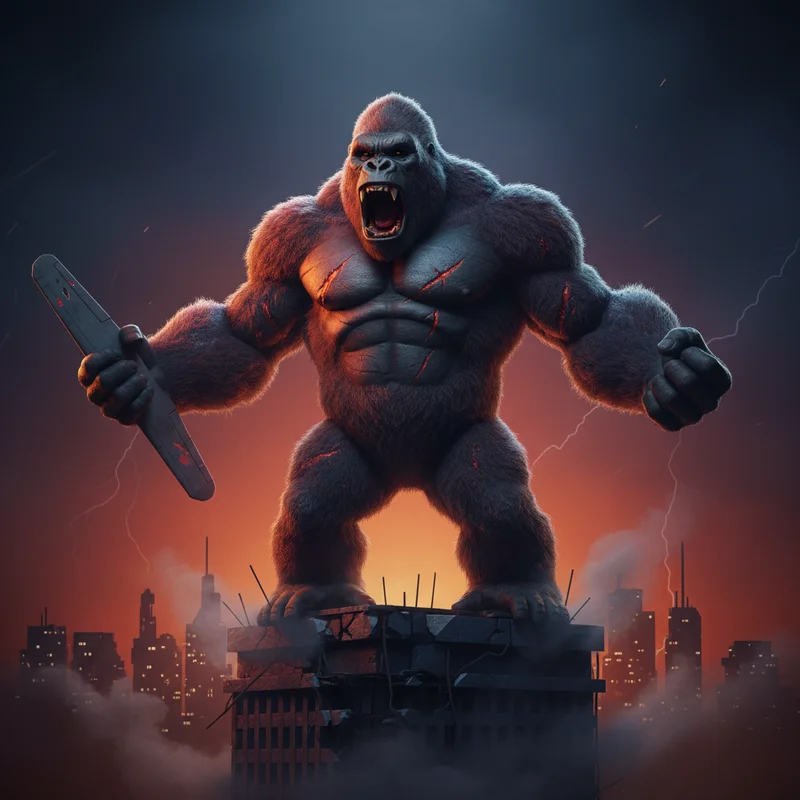
King Kong

King Kong

Giant ape with a thing for tall buildings.

Battle Analysis

Size King Kong Wins
30%
70%
Gorilla King Kong

Gorilla

The adult male silverback gorilla represents one of evolution's most impressive achievements in primate engineering. Standing at approximately 1.7 metres when upright and possessing an arm span exceeding 2.5 metres, these magnificent creatures command immediate respect in their forest habitats. Their sheer physical presence has evolved over millions of years to establish dominance hierarchies and protect familial groups from predators. Yet within the context of the animal kingdom, they remain proportional—bound by the physical laws that govern all terrestrial mammals.

King Kong

King Kong defies all biological constraints, existing at a scale that physics itself would protest. Depending upon the cinematic interpretation, this legendary beast ranges from 7 to 30 metres in height—dimensions that would collapse under their own mass were they subject to natural law. His fictional size serves a narrative purpose: to embody humanity's fear of nature uncontrolled. The 2005 iteration placed him at approximately 7.6 metres, whilst the MonsterVerse Kong towers at nearly 100 metres. Such magnitude exists purely to overwhelm the human observer.

VERDICT

Fictional liberty permits dimensions that biology cannot achieve, making Kong monumentally larger.
Strength King Kong Wins
30%
70%
Gorilla King Kong

Gorilla

The gorilla possesses strength roughly ten times that of an adult human male, capable of lifting approximately 800 kilograms. This remarkable power serves practical purposes: bending bamboo, displaying dominance, and protecting troop members from leopards and other threats. Scientific studies at various primate research centres have documented feats of strength that consistently astonish observers. Their muscular density and skeletal structure represent millions of years of evolutionary refinement for life in dense forest environments.

King Kong

King Kong's strength exists beyond measurement, constrained only by the imagination of screenwriters and visual effects artists. He has been depicted battling prehistoric creatures, military aircraft, and other giant monsters with apparent ease. In the MonsterVerse films, Kong wields improvised weapons and engages in combat with beings of equivalent mythological stature. His strength scales proportionally with his impossible size, creating a being capable of feats that exist entirely outside the realm of biological possibility.

VERDICT

Fictional amplification grants Kong strength limited only by narrative requirements.
Symbolic value King Kong Wins
30%
70%
Gorilla King Kong

Gorilla

The gorilla serves as a powerful symbol of wilderness preservation, endangered species awareness, and humanity's responsibility toward the natural world. Conservation organisations employ gorilla imagery to convey urgency about habitat destruction and poaching. In broader cultural terms, gorillas represent untamed nature, familial loyalty, and the complex emotions we project onto our closest relatives. Their gentle demeanour, contrasted with their formidable appearance, creates compelling symbolism about judging by appearances.

King Kong

King Kong embodies layers of meaning that scholars have debated for decades. He represents nature's revenge against industrialisation, the exploitation inherent in colonialism, beauty destroying the beast rather than the reverse, and humanity's eternal desire to capture and control the wild. His death scene—falling from human architecture, killed by human weapons—resonates as tragedy rather than victory. Kong symbolises every magnificent thing humanity has destroyed in its pursuit of spectacle and dominion.

VERDICT

Kong's layered symbolism encompasses colonialism, nature, tragedy, and human hubris.
Global recognition King Kong Wins
30%
70%
Gorilla King Kong

Gorilla

The gorilla enjoys widespread recognition as one of humanity's closest genetic relatives, featured prominently in wildlife documentaries, conservation campaigns, and educational materials worldwide. Icons such as Koko, who communicated through sign language, and the subjects of Dian Fossey's research have elevated gorilla awareness considerably. Yet this recognition often remains confined to academic circles and nature enthusiasts. The average person may recognise a gorilla image without possessing deeper knowledge of their behaviour, habitat, or conservation status.

King Kong

King Kong transcends cultural boundaries with a universality that few fictional creations achieve. Since his 1933 debut, Kong has become embedded in global popular consciousness—his image atop the Empire State Building ranks amongst cinema's most iconic moments. He has been reimagined across cultures, from Japanese films to animated series, from video games to theme park attractions. The mere silhouette of a giant ape against a skyline immediately evokes his legend, requiring no explanation across virtually any demographic.

VERDICT

Nearly a century of cinema has embedded Kong into universal cultural consciousness.
Evolutionary success Gorilla Wins
70%
30%
Gorilla King Kong

Gorilla

The gorilla represents approximately 7 million years of evolutionary development, sharing roughly 98% of its genetic material with humans. Their survival across geological ages, through ice ages and climatic shifts, demonstrates remarkable adaptive capacity. The development of complex social structures, tool use, and communication systems evidences evolutionary sophistication that commands scientific admiration. Despite current conservation challenges, the gorilla's biological lineage represents one of nature's most successful primate experiments.

King Kong

King Kong possesses no evolutionary history whatsoever, emerging fully formed from the creative minds of Merian C. Cooper and Edgar Wallace in 1933. His fictional backstory—an isolated ecosystem on Skull Island—attempts to explain his existence through pseudo-scientific speculation about evolutionary isolation. However, no biological pathway could produce a creature of his dimensions. In evolutionary terms, Kong is a failure before conception, impossible by every metric of natural selection and biomechanical constraint that governs actual organisms.

VERDICT

Seven million years of biological success comprehensively outweighs fictional non-existence.
👑

The Winner Is

King Kong

42 - 58

This analysis yields a conclusion both unexpected and illuminating. King Kong, despite his biological impossibility, emerges victorious through the paradoxical power of fiction to exceed reality's constraints. He is larger, stronger, more widely recognised, and more symbolically dense than his evolutionary inspiration. Yet this victory contains its own defeat: Kong can never breathe, never forage, never cradle an infant, never exist beyond the flickering light of projection.

The gorilla's triumph is quieter but more profound. In every forest clearing where a silverback guards his family, in every moment of interspecies recognition between human and ape, reality offers something mythology cannot: genuine presence. King Kong wins the comparison whilst the gorilla wins existence itself.

Gorilla
42%
King Kong
58%

Share this battle

More Comparisons