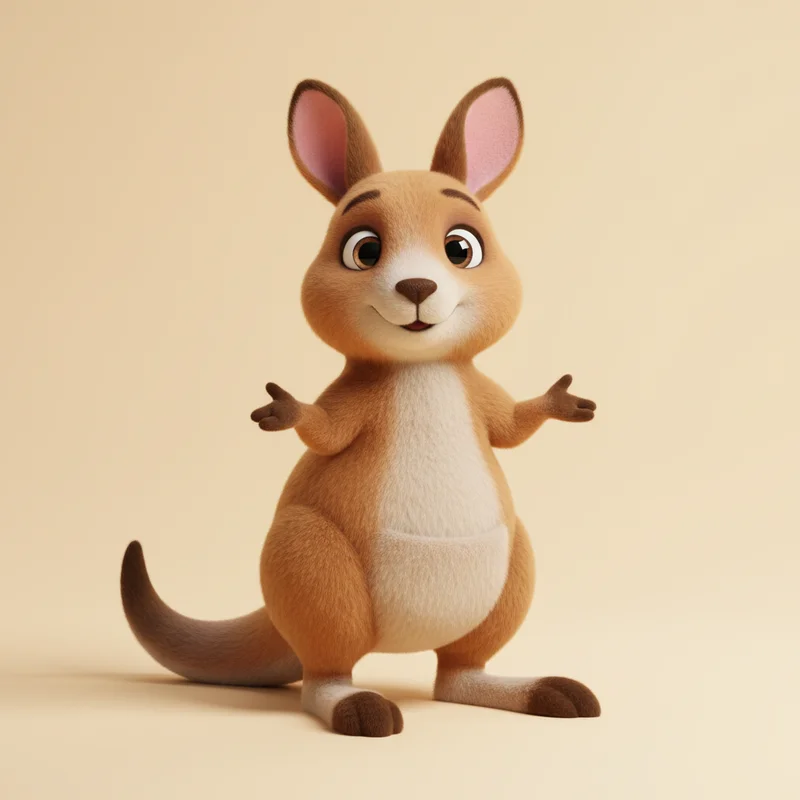

Kangaroo
The kangaroo demonstrates extraordinary locomotive capabilities that rank among the most impressive in the mammalian kingdom. The red kangaroo (Macropus rufus) has been documented achieving sustained speeds of 56 kilometers per hour, with sprint velocities reaching an astonishing 70 kilometers per hour over short distances. This places the kangaroo in direct competition with greyhounds and racehorses, neither of which can match its efficiency at speed.
The biomechanics underlying kangaroo locomotion represent a masterwork of evolutionary engineering. Unlike conventional quadrupedal running, which requires increasing energy expenditure at higher speeds, the kangaroo's hopping gait becomes more efficient as velocity increases. This counterintuitive phenomenon results from the creature's remarkable tendon elasticity: at cruising speeds, approximately 70% of the energy from each hop is stored in the tendons and recycled into the subsequent bound. The kangaroo has, in effect, developed biological springs that would make mechanical engineers weep with admiration.
At maximum velocity, a red kangaroo covers approximately 9 meters per bound, achieving ground clearance of up to 3 meters. The creature can maintain speeds exceeding 40 kilometers per hour for distances of 2 kilometers or more without apparent distress, a feat that would leave most terrestrial mammals gasping. In terms of pure speed metrics, the kangaroo operates in a performance category that few living creatures can challenge.
Rubber Duck
The rubber duck presents a fundamentally different velocity profile that must be assessed with appropriate scientific objectivity. Under its own power, the rubber duck achieves a sustained speed of precisely 0.0 kilometers per hour. It does not walk, hop, swim with purpose, or demonstrate any form of autonomous locomotion. The rubber duck, in perhaps its most honest quality, makes no pretense of mobility whatsoever.
However, the rubber duck demonstrates what physicists might term excellent velocity acquisition under external force. When propelled by a human hand, a rubber duck can achieve instantaneous velocities exceeding 30 kilometers per hour, though these speeds decay rapidly due to air resistance and the duck's suboptimal aerodynamic profile. When placed in moving water, rubber ducks have demonstrated remarkable passive navigation capabilities, as evidenced by the famous 1992 container spill that saw specimens travel over 17,000 kilometers across the Pacific Ocean.
The rubber duck's relationship with speed exists primarily in the relative rather than absolute domain. In bathwater, where velocities rarely exceed 0.5 meters per second, the rubber duck matches or exceeds the speed of its aquatic environment. From the perspective of a toddler splashing enthusiastically, the rubber duck appears to move with considerable urgency. Speed, like so many things, is a matter of context and the rubber duck has wisely chosen a context in which its performance appears adequate.
VERDICT
The speed assessment yields a result so decisive that further elaboration seems almost unnecessary. The kangaroo achieves velocities that would generate speeding tickets in suburban residential zones; the rubber duck requires external assistance to move at all. This is not a close competition, and pretending otherwise would represent a failure of scientific integrity.
The kangaroo's victory in this category reflects 15 million years of evolutionary pressure from predators, competitors, and the vast Australian landscape. The rubber duck, having evolved in factories rather than savannas, faced no selection pressure for speed and therefore developed none. This outcome was, in retrospect, entirely predictable. The kangaroo claims this criterion with a margin that approaches infinity.