
Topic Battle

Where Everything Fights Everything

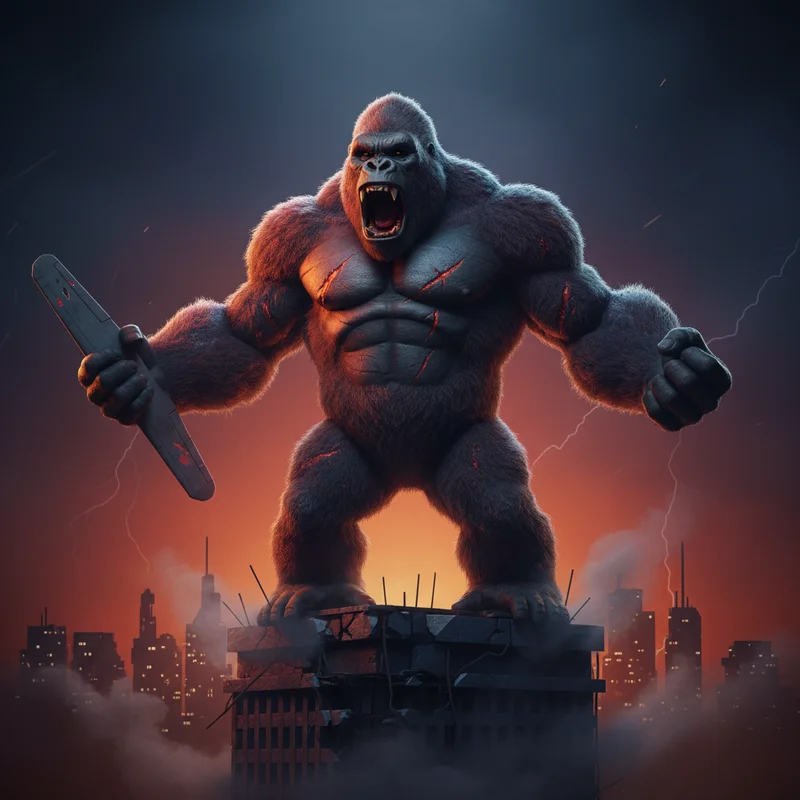
King Kong

King Kong

Giant ape with a thing for tall buildings.

VS
Lego

Lego

Interlocking plastic bricks and barefoot landmines.

Battle Analysis

Cultural impact Lego Wins
30%
70%
King Kong Lego

King Kong

King Kong's cultural footprint cannot be overstated. The original 1933 film pioneered stop-motion animation techniques that influenced generations of filmmakers, from Ray Harryhausen to Peter Jackson. The image of the great ape atop the Empire State Building has become one of cinema's most recognisable moments, reproduced countless times across media, merchandise, and parody.

The character has spawned numerous remakes, sequels, and crossover events, most notably the MonsterVerse franchise that has grossed over two billion dollars globally. Kong represents humanity's complex relationship with nature: feared, exploited, and ultimately mourned. Academic papers examining the racial and colonial subtexts of the original film number in the hundreds.

Yet King Kong remains fundamentally a passive cultural artefact. Audiences consume his story but do not participate in it. His influence, whilst profound, flows in a single direction.

Lego

Lego has transcended the category of mere toy to become a universal language of construction. The brick's elegant simplicity, with its precisely engineered clutch power of approximately one newton, allows infinite creative expression. Over 400 billion Lego elements have been produced, sufficient to provide sixty-two bricks for every human being on Earth.

The cultural penetration of Lego defies comprehensive measurement. Lego themes have encompassed Star Wars, Harry Potter, Marvel, DC, and hundreds of original intellectual properties. The Lego Movie and its sequels grossed nearly one billion dollars whilst simultaneously functioning as feature-length brand experiences. Legoland theme parks attract over fifteen million visitors annually across nine global locations.

Most significantly, Lego enables active participation in culture rather than passive consumption. Children and adults alike become creators, architects, and storytellers. This participatory dimension fundamentally distinguishes Lego from conventional entertainment media.

VERDICT

Whilst King Kong commands immediate recognition and emotional resonance, Lego's interactive cultural model proves more profound. Kong is observed; Lego is experienced. This distinction proves decisive in assessing lasting cultural impact.

Economic influence Lego Wins
30%
70%
King Kong Lego

King Kong

The King Kong franchise has generated substantial revenue across its nine-decade history. The original 1933 film reportedly cost $672,000 to produce and earned approximately $10 million during its initial release, an extraordinary return for the Depression era. Peter Jackson's 2005 remake grossed $562 million globally against a $207 million budget.

The MonsterVerse franchise, incorporating Kong: Skull Island and Godzilla vs. Kong, has collectively grossed over two billion dollars. Licensing revenues from merchandise, video games, and theme park attractions add further value, though precise figures remain proprietary.

However, Kong's economic activity occurs in sporadic bursts coinciding with new film releases. Between productions, the intellectual property generates relatively modest passive income. The character's earning potential depends entirely upon continued studio investment in new content.

Lego

The Lego Group's economic footprint dwarfs most entertainment franchises. Annual revenues exceeded 64 billion Danish kroner (approximately $9.4 billion USD) in recent fiscal years, placing Lego among the world's largest toy manufacturers. The company produces over nineteen billion elements annually, or roughly 36,000 pieces per minute.

Beyond direct sales, Lego's economic influence extends through licensing partnerships worth billions, theme parks generating hundreds of millions in annual attendance revenue, and a film division that has produced multiple box office successes. The secondary market for rare and vintage sets adds further economic activity, with certain sets appreciating faster than gold or traditional equities.

Employment figures reveal Lego's scale: over 24,000 employees worldwide, with manufacturing facilities across Denmark, Mexico, Hungary, and China. The company's economic activity is continuous and diversified, not dependent on periodic releases.

VERDICT

Whilst King Kong has generated impressive returns relative to investment, Lego operates at an entirely different economic magnitude. The comparison between periodic film releases and continuous global manufacturing reveals a fundamental asymmetry in commercial influence.

Longevity potential Lego Wins
30%
70%
King Kong Lego

King Kong

King Kong's longevity depends upon continued cultural relevance and studio investment. The character has successfully transitioned across nine decades, adapting to changing filmmaking technologies and audience expectations. Each generation has received its own interpretation, from stop-motion to CGI, from horror to action spectacle.

However, Kong faces existential challenges. His narrative fundamentally requires tragedy: beauty killing the beast. This limited dramatic range constrains storytelling possibilities. Furthermore, evolving sensitivities regarding the original film's problematic elements may complicate future adaptations.

As intellectual property, Kong exists in a complex legal landscape. Multiple studios hold various rights, potentially limiting coherent franchise development. His survival depends entirely upon human decisions to continue producing content featuring the character.

Lego

Lego's longevity rests upon foundations of extraordinary durability. The brick's design has remained fundamentally unchanged since 1958, yet continues to meet contemporary expectations. Unlike media properties dependent on narrative freshness, Lego's appeal derives from infinite creative possibility that never becomes dated.

The physical product demonstrates remarkable permanence. ABS plastic resists degradation for hundreds of years under normal conditions. Vintage sets remain fully functional, often commanding premium prices. Environmental concerns regarding plastic persistence are being addressed through plant-based and recycled alternatives.

Most significantly, Lego's business model ensures perpetual relevance through licensing partnerships with whatever properties capture public imagination. Star Wars today, tomorrow's phenomena tomorrow. The brick adapts; the product endures. No studio decisions threaten its existence.

VERDICT

King Kong's continued existence requires active cultivation by rights holders, whilst Lego perpetuates itself through inherent utility and adaptable partnerships. The brick's longevity appears limited only by the persistence of ABS plastic, measured in centuries rather than decades.

Destructive capacity King Kong Wins
70%
30%
King Kong Lego

King Kong

King Kong's capacity for destruction represents his most celebrated attribute. Across various iterations, Kong has demolished elevated railways, aircraft, military installations, and significant portions of urban infrastructure. The 2017 Skull Island depiction shows Kong defeating military helicopters with thrown trees, whilst the MonsterVerse version engages in city-levelling combat with similarly scaled opponents.

Conservative damage estimates for Kong's 1933 Manhattan rampage suggest destruction valued in the tens of millions of dollars (inflation-adjusted). The MonsterVerse conflicts would reasonably cause damage in the hundreds of billions, comparable to major natural disasters. Kong's destructive methodology combines primate intelligence with overwhelming physical force.

Importantly, Kong's destruction is targeted and intentional. He destroys with purpose, whether defending territory, pursuing objectives, or expressing rage. This agency distinguishes his destructive capacity from mere natural phenomena.

Lego

Lego's destructive capacity operates through an entirely different mechanism: the unshod human foot. Studies suggest that stepping on a Lego brick produces pain disproportionate to the object's mass, owing to the brick's rigid construction and the foot's concentration of nerve endings. Emergency room records, whilst not specifically tracking Lego injuries, suggest thousands of annual incidents involving small plastic objects.

Beyond physical pain, Lego enables the construction of destructive implements. Enthusiasts have built functional catapults, crossbows, and pneumatic cannons capable of propelling projectiles at considerable velocity. The Lego Technic range specifically facilitates mechanical constructions with moving parts.

However, Lego's destructive capacity remains fundamentally derivative rather than inherent. The bricks themselves cause only minor injury; any larger destruction requires human agency and construction. Lego is a medium for destruction, not a destructive force itself.

VERDICT

In the realm of pure destruction, King Kong reigns supreme. His physical power enables devastation at scales Lego cannot approach, regardless of construction ingenuity. The great ape's rampage through Manhattan remains unmatched by any arrangement of plastic bricks.

Structural integrity Lego Wins
30%
70%
King Kong Lego

King Kong

King Kong's structural specifications vary considerably across cinematic interpretations. The 1933 original depicted the ape at approximately 7.3 metres in height, whilst Peter Jackson's 2005 version measured 7.6 metres. The MonsterVerse iteration, however, presents a creature exceeding 100 metres, necessitating skeletal and muscular systems that defy known biological principles.

Engineering analyses suggest that a primate of Kong's MonsterVerse dimensions would require bones of extraordinary density simply to support standing locomotion. The square-cube law presents insurmountable challenges: as volume increases cubically, structural members must grow disproportionately to maintain integrity. A 100-metre ape would likely collapse under its own mass.

Furthermore, Kong's structural integrity proves consistently vulnerable to military hardware. Biplanes felled the original; modern ordnance poses even greater threats. His flesh, however impressive, remains fundamentally organic and therefore destructible.

Lego

The Lego brick represents a triumph of precision engineering. Each element is manufactured to tolerances of two micrometres, ensuring consistent clutch power across bricks produced decades apart. A brick from 1958 connects seamlessly with one manufactured yesterday. This backward compatibility across seventy years of production remains unprecedented in consumer products.

Lego structures demonstrate remarkable load-bearing capacity relative to their mass. Engineering students have calculated that a theoretical tower of standard 2x4 bricks could reach 375,000 bricks in height before the bottom brick failed under compression, approximately 3.5 kilometres. Practical demonstrations include a full-scale functional Lego house and vehicles capable of carrying passengers.

The distributed nature of Lego construction means that localised damage affects only individual bricks, not structural integrity. There is no single point of failure. Removed elements are simply replaced, rendering Lego structures effectively self-healing given sufficient spare components.

VERDICT

King Kong's impressive physicality cannot overcome the fundamental implausibility of his existence at scale. Lego, by contrast, demonstrates structural properties that improve with proper engineering application. The brick's modularity creates resilience that monolithic organisms cannot match.

👑

The Winner Is

42 - 58

Our comprehensive analysis reveals a perhaps unexpected conclusion. King Kong, for all his thunderous magnificence, represents a fundamentally finite phenomenon: a character bound by narrative constraints, dependent upon studio investment, and subject to the vagaries of cultural fashion.

Lego, by contrast, has achieved something approaching immortality. The brick's elegant simplicity enables infinite expression. Its business model ensures perpetual relevance. Its physical product persists across generations. Where Kong must be periodically resurrected through expensive productions, Lego quietly accumulates, brick by brick, in homes across the world.

The great ape's victories in destructive capacity cannot offset defeats across cultural participation, structural engineering, economic scale, and longevity potential. Kong destroys impressively but temporarily; Lego constructs permanently. In the final accounting, creation surpasses destruction.

The Danish brick emerges victorious with a score of 58 to 42.

King Kong
42%
Lego
58%

Share this battle

More Comparisons