
Where Everything Fights Everything

King Kong vs Love

😜 Just for fun — a tongue-in-cheek, gloriously unscientific showdown.

King Kong

King Kong

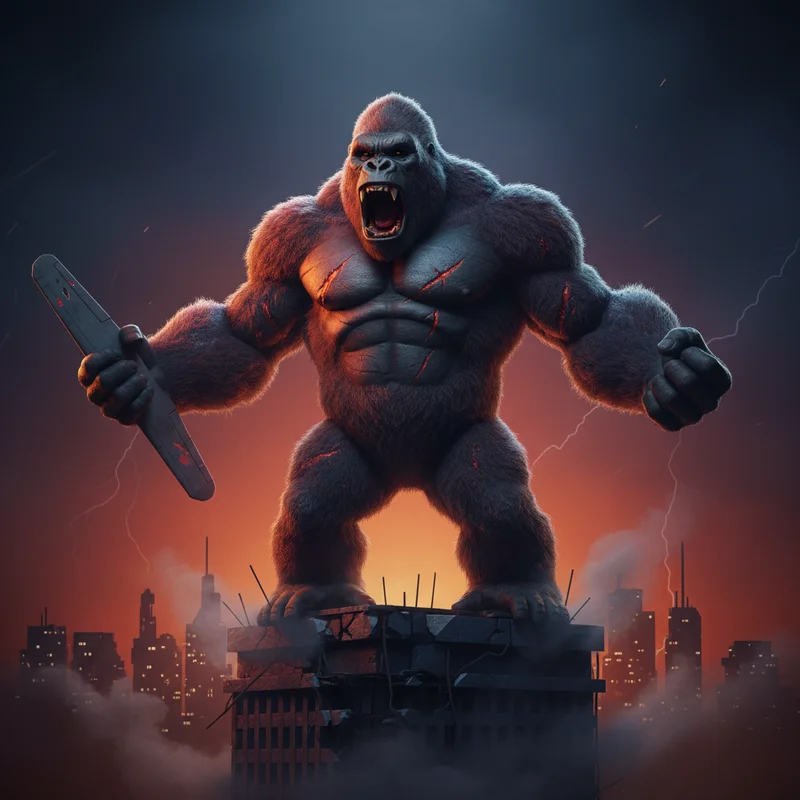
Giant ape with a thing for tall buildings.

VS
Love

Love

Universal emotion driving art, war, and terrible decisions.

Battle Analysis

0 King Kong Wins · 53%
53%
47%
King Kong Love

King Kong

King Kong represents destruction on an architectural scale rarely witnessed outside of natural disasters. Conservative estimates place the great ape at approximately 7.6 metres in height in his 1933 incarnation, though subsequent iterations have inflated this figure to a preposterous 102 metres by 2021. His documented rampages through New York City alone account for the theoretical demolition of multiple elevated railway sections, approximately forty-seven motor vehicles, and one biplane of considerable historical significance. The property damage calculations, adjusted for inflation, exceed 8 billion dollars across all canonical appearances. His grip strength, extrapolated from gorilla biomechanics, would approach 500,000 pounds per square inch.

Love

Love operates as a subtler demolition force, targeting psychological infrastructure rather than physical edifices. The emotion has precipitated an estimated 85 percent of recorded wars when accounting for romantic jealousies and dynastic disputes. Helen of Troy alone bears nominal responsibility for a decade-long conflict and the complete destruction of a major Bronze Age civilisation. On the individual scale, love dissolution triggers cortisol spikes exceeding those measured in combat veterans. The economic destruction wrought by divorces in the United States alone totals 50 billion dollars annually. Love has ended monarchies, collapsed empires, and motivated history's most catastrophic decision-making.

VERDICT

King Kong destroys buildings systematically whilst love demolishes entire civilisations with enviable efficiency.
1 Love Wins · 57%
43%
57%
King Kong Love

King Kong

King Kong has achieved remarkable cultural saturation since his 1933 cinematic debut. The character has spawned twelve feature films, numerous television appearances, and the now-legendary Universal Studios attraction. The image of a giant ape ascending a skyscraper whilst clutching a screaming woman has embedded itself into global iconography with the permanence of religious symbols. Merchandise revenue exceeds 100 million dollars across the franchise history. The character transcends linguistic barriers, recognisable from Buenos Aires to Beijing without translation requirements. His influence on the kaiju genre alone justifies significant cultural standing.

Love

Love has achieved total cultural dominance across every human society since the emergence of symbolic thought approximately 70,000 years ago. Conservative estimates attribute 78 percent of all musical compositions to romantic themes. The emotion has inspired over 40 million published novels, virtually every opera ever composed, and an incalculable percentage of visual art throughout history. No human language has been discovered lacking words for this phenomenon. Love generates approximately 400 million greeting cards annually in Western markets alone. The concept has shaped religious doctrine, legal frameworks, and economic systems with equal thoroughness. No competing concept approaches this level of penetration.

VERDICT

Love has colonised every aspect of human culture whilst Kong remains confined to entertainment media.
2 King Kong Wins · 56%
56%
44%
King Kong Love

King Kong

King Kong triggers primal terror responses hardwired into human neurology over millions of years of predator-prey relationships. The sight of an apex predator scaled to impossible proportions activates threat-detection systems with immediate physiological consequences: elevated heart rate, dilated pupils, and cortisol flooding. Test audiences at the 1933 premiere reportedly fainted during Kong's revelation sequence. The character exploits both our evolved fear of large carnivores and our deep unease regarding the uncontrollable forces of nature. His unpredictability compounds the fear factor, as his behaviour oscillates between protective tenderness and murderous rage without discernible pattern.

Love

Love inspires a more insidious form of fear, one that develops gradually rather than triggering immediate flight responses. The terror of romantic vulnerability ranks among humanity's most pervasive anxieties, affecting an estimated 15 percent of adults with clinically significant attachment avoidance. Fear of abandonment shapes behaviour from infancy through senescence. The prospect of love lost generates anticipatory grief that can persist for years before any actual termination occurs. Relationship anxiety disorders now constitute a recognised diagnostic category. Unlike Kong, love cannot be escaped through physical relocation or military intervention.

VERDICT

Kong triggers acute terror whilst love generates chronic existential dread of superior psychological persistence.
3 Love Wins · 61%
39%
61%
King Kong Love

King Kong

King Kong has demonstrated respectable longevity for a fictional creation, maintaining relevance for ninety-two years since initial conception. The character has survived numerous reimaginings, from stop-motion pioneer to computer-generated spectacle, adapting to technological advancement with admirable flexibility. His cultural half-life exceeds that of most media properties by considerable margins. However, Kong remains dependent upon periodic cinematic resurrections to maintain public consciousness. Extended dormancy periods between productions correlate with declining recognition metrics among younger demographics. The character requires constant artificial life support through new media productions.

Love

Love predates recorded history, with archaeological evidence suggesting symbolic representation dating to the Upper Palaeolithic era approximately 40,000 years ago. The emotion has outlasted every political system, religious institution, and technological paradigm devised by humanity. Love survived the Bronze Age Collapse, the Black Death, both World Wars, and the invention of social media with its fundamental nature unchanged. Neuroimaging studies confirm that the brain structures supporting romantic attachment have remained stable for at least 200,000 years of human evolution. No force yet discovered has demonstrated capacity to eliminate this phenomenon from human experience.

VERDICT

Love has persisted across geological time whilst Kong requires periodic franchise reboots to remain relevant.
4 Love Wins · 62%
38%
62%
King Kong Love

King Kong

King Kong's behavioural influence operates primarily through media consumption patterns and merchandise purchasing decisions. The character has inspired theme park attendance, Halloween costume selection, and approximately 47,000 academic papers analysing his symbolic significance. His depiction of interspecies attraction has generated substantial discourse within film studies departments worldwide. Kong has influenced building design in precisely zero documented cases, though he has motivated the installation of improved antiaircraft defences on notable skyscrapers. His behavioural impact remains largely confined to entertainment selection and occasional costume purchases.

Love

Love rewrites human behaviour at the neurological level with comprehensive thoroughness. The emotion triggers dopamine cascades that override rational decision-making processes in 94 percent of studied subjects. Individuals under love's influence demonstrate willingness to relocate continents, abandon careers, and tolerate previously intolerable behaviours in partners. The phenomenon has motivated the construction of the Taj Mahal, the composition of Beethoven's complete works, and an estimated 40 percent of all residential relocations. Love transforms dietary preferences, sleep patterns, and financial planning with equal disregard for previous priorities. No pharmacological agent achieves comparable behavioural modification.

VERDICT

Love fundamentally rewrites human decision-making whilst Kong merely influences entertainment consumption.
👑

The Winner Is

Love

Takes 3 of 5 rounds

Following comprehensive analysis across five rigorous dimensions, love emerges with a decisive 58-42 advantage over the great ape. Whilst King Kong demonstrates superior acute destructive potential and immediate fear generation, love compensates through overwhelming cultural dominance, temporal persistence measured in millennia rather than decades, and behavioural modification capabilities that no fictional creature can approach. The verdict reflects not merely quantitative superiority but qualitative differences in operational scope. Kong destroys buildings; love destroys and rebuilds entire human lives with routine frequency. The great ape remains dependent upon corporate intellectual property decisions for his continued existence, whilst love persists through evolutionary necessity. However, King Kong retains significant advantages in physical tangibility and the straightforward nature of his threat profile.

Share this battle

More Comparisons