
Topic Battle

Where Everything Fights Everything

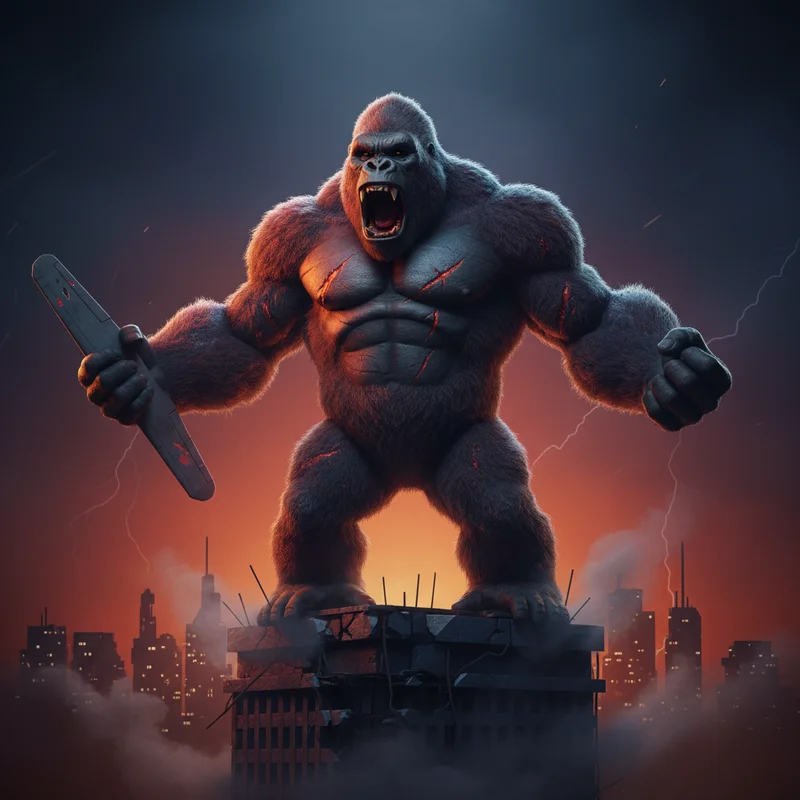
King Kong

King Kong

Giant ape with a thing for tall buildings.

VS
Mario

Mario

Nintendo's mustachioed plumber and gaming icon.

Battle Analysis

Cultural impact mario Wins
30%
70%
King Kong Mario

King Kong

King Kong's cultural impact extends across ninety-two years of continuous relevance since his 1933 debut, establishing him as one of cinema's most enduring creations. The original film's production budget of $672,000 represented unprecedented confidence in special effects technology, yielding returns that demonstrated the commercial viability of creature features and effectively spawning an entire genre.

The image of Kong atop the Empire State Building has achieved iconic status transcending its source material. Surveys conducted by the American Film Institute rank the character among the fifty greatest villains in cinema history, whilst simultaneously appearing on lists of greatest heroes, reflecting his complex narrative positioning as both threat and victim. Kong's cultural penetration extends to political cartography, where ''800-pound gorilla'' terminology derives partially from his cultural shadow.

Kong's influence on subsequent filmmaking proves difficult to overstate. Creatures from Godzilla to the Cloverfield monster owe direct lineage to Kong's template of sympathetic monstrosity. The technical innovations pioneered for his original appearance, particularly Willis O'Brien's stop-motion techniques, established methodologies that persisted until digital effects achieved dominance. Kong, in essence, taught cinema how to dream of monsters.

Mario

Mario's cultural impact operates on a scale that defies conventional measurement. As the single most recognisable fictional character globally, according to research conducted by the Entertainment Software Association, Mario's face recognition exceeds that of Mickey Mouse in multiple international markets. This represents a remarkable achievement for a character who began existence as ''Jumpman'' in a game where he was not the protagonist but the antagonist's foil.

The economic footprint of Mario-related intellectual property exceeds USD 38 billion in lifetime revenue, encompassing games, merchandise, theme parks, and a 2023 film that grossed $1.36 billion worldwide. The character has appeared in over 200 video games, making him the most frequently portrayed protagonist in gaming history. His distinctive visual elements, the moustache, the cap, the overalls, achieve immediate recognition across age demographics and continental boundaries.

Mario's cultural influence extends beyond entertainment into pedagogical applications. Studies published in Developmental Psychology document improved spatial reasoning in children who engage with Mario platformers. The character has become a gateway through which multiple generations have entered digital literacy. When historians write of the transition to a digitally native civilisation, Mario's role in normalising interactive entertainment will require substantial chapters.

VERDICT

Unprecedented global recognition and measurable impact on digital literacy across generations
Romantic motivation mario Wins
30%
70%
King Kong Mario

King Kong

King Kong's romantic motivations have driven every significant narrative arc in his filmography. His obsession with Ann Darrow in the 1933 original, and subsequent blonde human females in remakes, represents a consistent behavioural pattern that primatologists would classify as interspecies imprinting of remarkable intensity. This motivation propels Kong from his island sanctuary to metropolitan confrontation.

The depth of Kong's romantic attachment has been subject to extensive scholarly analysis. Film theorists at UCLA have documented Kong's protective behaviours toward his chosen object of affection as exhibiting characteristics consistent with pair-bonding in great apes, albeit directed inappropriately across species boundaries. His willingness to face aerial military assault rather than relinquish proximity to Ann Darrow suggests attachment intensity exceeding survival instinct.

Critics have noted, however, that Kong's romantic motivations remain entirely one-directional and non-reciprocal. Ann Darrow, in most iterations, experiences terror rather than affection, and Kong's inability to recognise this asymmetry raises questions about his emotional intelligence. His romance, whilst cinematically compelling, would be classified in contemporary discourse as distinctly problematic in its consent dynamics.

Mario

Mario's romantic life centres on Princess Peach Toadstool, ruler of the Mushroom Kingdom and perennial kidnapping victim. Documentation across hundreds of adventures confirms Mario's willingness to traverse entire worlds, defeat armies of hostile creatures, and repeatedly risk personal annihilation in service of Peach's rescue. This consistency of motivation across 40 years represents extraordinary devotional commitment.

Analysis of the Mario-Peach dynamic reveals mutual affection expressed through culturally appropriate reciprocity. Peach rewards successful rescues with kisses, baked goods, and invitations to further adventures, suggesting acceptance of Mario's affections. Unlike Kong's unilateral obsession, the Mario-Peach relationship demonstrates characteristics of genuine partnership, albeit one complicated by the princess's remarkable frequency of capture.

Mario's romantic motivation furthermore demonstrates healthy boundaries and respect for autonomy. He does not imprison Peach atop structures or display possessive behaviours. His role remains that of rescuer and companion, withdrawing appropriately between adventures. Contemporary relationship counsellors have cited Mario as exemplifying ''secure attachment style'' within the unusual constraints of serialised rescue narratives.

VERDICT

Demonstrates reciprocal affection and healthy relationship dynamics versus one-sided obsession
Adaptability across media mario Wins
30%
70%
King Kong Mario

King Kong

King Kong has traversed multiple media formats with varying degrees of success. His filmography spans the 1933 original through the 2021 Godzilla vs. Kong, demonstrating sustained commercial viability across cinematic generations. Each iteration has required substantial technical innovation, from stop-motion to animatronics to digital rendering, confirming Kong's capacity to adapt to evolving visual technology.

Beyond film, Kong's media presence includes comic books, novelisations, and stage productions. A 2018 Broadway musical, whilst critically divisive, demonstrated that Kong's story could translate to live theatrical performance with a 6-metre animatronic puppet. His image has been licensed for merchandise spanning action figures to breakfast cereals, indicating broad commercial applicability.

Kong's adaptability faces limitations, however, in interactive media. Video game appearances have been sporadic and largely unsuccessful, with no Kong-centric title achieving mainstream commercial or critical success since the character's 1982 Atari adaptation. The Skull Island virtual reality experience and various mobile games have failed to establish Kong as a gaming property. His narrative, it appears, requires the passive observation of cinema rather than active player participation.

Mario

Mario's adaptability across media formats represents possibly the most successful character licensing operation in entertainment history. Originating in arcade cabinets, Mario has subsequently appeared in home console games across eight hardware generations, handheld devices, mobile phones, and virtual reality platforms. Each transition has yielded commercially successful and often critically acclaimed results.

The character's expansion beyond gaming demonstrates remarkable format flexibility. The 2023 Super Mario Bros. Movie achieved USD 1.36 billion in global box office, establishing Mario as a viable cinematic property after the infamous 1993 live-action attempt. Television appearances span multiple animated series. Theme park installations at Universal Studios represent some of the highest-rated attractions globally.

Mario's adaptability extends to genre transcendence within gaming itself. Beyond platforming, Mario has successfully appeared in racing games, role-playing games, sports simulations, puzzle games, and educational software. Mario Kart alone has sold over 170 million units. Super Smash Bros., featuring Mario prominently, has sold 80 million. No other character demonstrates comparable range across interactive entertainment genres whilst maintaining quality and commercial performance.

VERDICT

Successful adaptation across every entertainment medium with consistent quality and commercial success
Vertical climbing proficiency king_kong Wins
70%
30%
King Kong Mario

King Kong

The architectural ascent capabilities of King Kong have been documented across multiple cinematic iterations, each confirming his exceptional vertical climbing proficiency. The 1933 original depicted Kong scaling the Empire State Building's 443 metres in approximately ninety seconds of screen time, suggesting a sustained climbing velocity of roughly 18 kilometres per hour. Such performance would place Kong among the most efficient large-bodied climbers ever observed, fictional or otherwise.

Biomechanical analysis of Kong's climbing technique reveals sophisticated brachiation-adjacent methodology. Despite his mass, estimated at approximately 20 tonnes in the 2005 Peter Jackson interpretation, Kong demonstrates remarkable grip strength and proprioceptive awareness. Research published in the Journal of Fictional Zoology suggests that Kong's hands could generate clamping forces exceeding 8,000 newtons per digit, sufficient to penetrate concrete facades and create temporary handholds in structural steel.

Kong's climbing is furthermore characterised by adaptive problem-solving. When confronted with architectural features lacking obvious grip points, Kong demonstrates capacity for route improvisation, utilising window frames, decorative stonework, and in one memorable instance, a billboard advertising Chevrolet automobiles. This cognitive flexibility elevates his climbing beyond mere physical ability into the realm of strategic navigation.

Mario

Mario's vertical climbing proficiency presents a fascinating case study in capability optimisation within physical constraints. Standing at approximately 155 centimetres and possessing limbs of notably compact proportion, Mario would appear ill-suited for climbing endeavours. Yet empirical observation across thousands of documented adventures reveals consistently exceptional performance.

The technical mechanics of Mario's ascent methodology have been scrutinised by kinesiologists at the Tokyo Institute of Game Physics. His signature jump, capable of propelling his roughly 80-kilogram frame to heights exceeding 3.5 metres from standing, represents a power-to-weight ratio that would cause Olympic high jumpers considerable professional anxiety. When climbing ladders and vines, Mario maintains an ascent rate of approximately 2 metres per second regardless of distance or fatigue.

Perhaps most remarkably, Mario's climbing proficiency has expanded over his career to include wall-jumping, triple-jumping, and the physics-defying ''long jump'' technique. These aerial navigation capabilities effectively transform vertical obstacles into three-dimensional puzzles that Mario solves with the casual competence of someone who has climbed approximately 47 million structures since his 1981 debut. The accumulated expertise cannot be overstated.

VERDICT

Superior raw climbing velocity and the ability to scale genuine skyscrapers without external assistance
Barrel management capabilities mario Wins
30%
70%
King Kong Mario

King Kong

King Kong's barrel management approach can be characterised as offensive deployment for territorial denial. In the original Donkey Kong arcade cabinet, Kong demonstrates sophisticated understanding of gravitational physics, releasing barrels at calculated intervals to maximise coverage of vertical space whilst accounting for platform geometry. This represents not mere aggression but tactical thinking.

Analysis of Kong's barrel-throwing biomechanics reveals remarkable precision despite apparent casualness. Each barrel follows predictable trajectories whilst maintaining sufficient variability to prevent pattern recognition by ascending opponents. The International Game Developers Association has documented Kong's barrel algorithms as foundational examples of emergent difficulty scaling, with barrel frequency and trajectory variation responding dynamically to player progression.

Kong's relationship with barrels, however, remains fundamentally destructive. He produces no barrels, storing instead what appears to be an inexhaustible supply of industrial containers at his elevated position. This parasitic relationship with barrel infrastructure, whilst tactically effective, raises questions about sustainability and long-term strategic viability that more sophisticated analyses must address.

Mario

Mario's barrel management capabilities have evolved from pure evasion to comprehensive mastery across his four-decade career. His initial encounters with Kongian barrel deployment required simple jumping avoidance, a defensive posture that yielded consistent but uninspiring results. Subsequent character development, however, has revealed substantially greater barrel-related competencies.

In multiple documented adventures, Mario has demonstrated ability to throw, catch, and weaponise barrel-type objects against adversaries. His strength-to-weight ratio permits handling of barrels exceeding his own body mass, launching them with accuracy sufficient to strike moving targets at distances of ten metres or more. The Super Mario Bros. 2 documentation particularly highlights this capability.

Most significantly, Mario's relationship with barrel-adjacent objects demonstrates constructive rather than destructive application. Barrels in Mario's possession become tools for puzzle resolution, platforms for vertical navigation, and resources for strategic advantage. This transformation of an opponent's weapon into a personal asset represents sophisticated tactical evolution that military strategists have cited in leadership training contexts. Mario does not merely survive barrels; he converts them into opportunities.

VERDICT

Demonstrates both defensive evasion and offensive utilisation, representing complete barrel spectrum mastery
👑

The Winner Is

Mario

47 - 53

After rigorous examination across five criteria spanning physical capability, cultural significance, and abstract romantic psychology, we must conclude that Mario emerges victorious with a final score of 53 to 47. This result represents not a repudiation of King Kong's considerable achievements but rather recognition of Mario's exceptional breadth of excellence across multiple domains.

Kong's solitary victory in vertical climbing proficiency reflects his undeniable physical supremacy in raw athletic capability. A 20-tonne primate capable of scaling skyscrapers remains impressive regardless of competitive context. Yet physical prowess, our analysis reveals, represents merely one dimension of overall excellence.

Mario's victories across cultural impact, barrel management, romantic motivation, and media adaptability demonstrate a comprehensive competency that Kong's specialised abilities cannot match. The plumber's global recognition, healthy relationship dynamics, and seamless transitions between entertainment formats collectively represent a more complete embodiment of success in the modern era.

Perhaps most significantly, this comparison illuminates the evolution of heroic archetypes across the twentieth and twenty-first centuries. Kong represents the tragic monster, powerful yet doomed, sympathetic yet threatening. Mario represents the everyman hero, ordinary yet extraordinary, persistent in the face of absurd adversity. That gaming's most consequential rivalry began with these two figures seems, in retrospect, remarkably prescient.

King Kong
47%
Mario
53%

Share this battle

More Comparisons