
Topic Battle

Where Everything Fights Everything

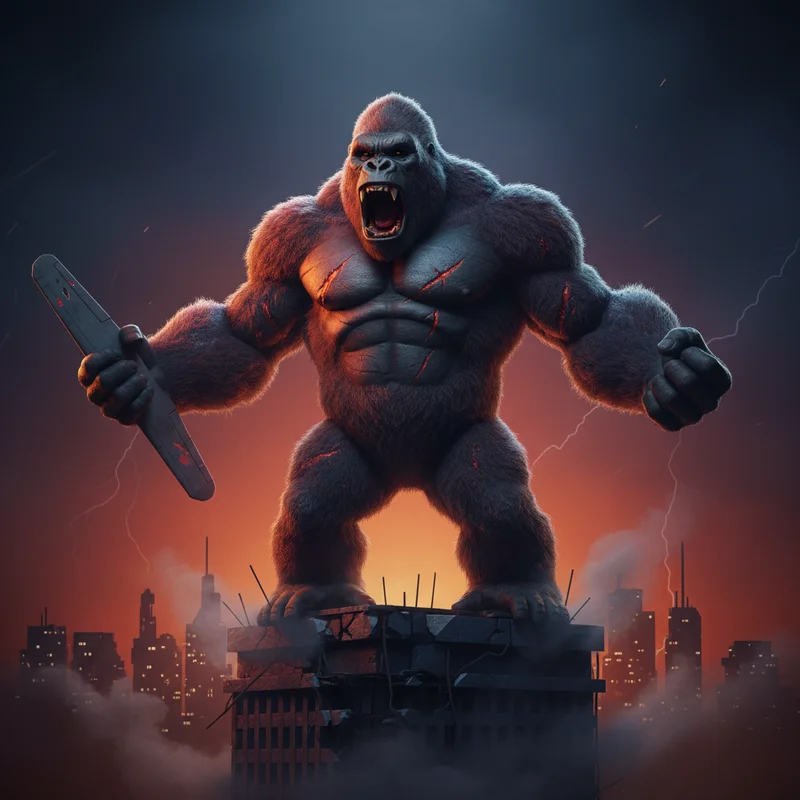
King Kong

King Kong

Giant ape with a thing for tall buildings.

VS
Money

Money

Abstract concept that runs the world.

Battle Analysis

Cultural impact Money Wins
30%
70%
King Kong Money

King Kong

King Kong's cultural footprint spans nine decades of continuous reinvention, from the stop-motion marvel of 1933 to Peter Jackson's three-hour epic and the MonsterVerse's CGI spectacular. The image of a giant ape atop a skyscraper has achieved universal recognition, transcending language and nationality to become perhaps cinema's most iconic visual metaphor.

The great ape has inspired countless imitators, parodies, and homages across every medium. References appear in over 200 films, countless television programmes, and advertising campaigns spanning nearly a century. The phrase 'eighth wonder of the world' has become permanently associated with the character, elevating a fictional primate to quasi-mythological status.

Kong's narrative, at its core, examines civilisation's relationship with the wild, the exploitation of nature for spectacle, and the beauty-and-beast archetype. Literary scholars continue to debate the allegorical implications, ensuring perpetual academic relevance.

Money

Money's cultural impact predates recorded history and shapes virtually every human interaction. From the earliest shell currencies to cryptocurrency, the concept of stored value has determined the rise and fall of empires, inspired revolutions, and fundamentally altered human social organisation. Its cultural penetration is absolute and inescapable.

Consider that every major religion addresses money directly, every language contains hundreds of money-related idioms, and every child learns to count using currency as their primary example. The pursuit of wealth has generated literature from Dickens to Fitzgerald, philosophy from Aristotle to Marx, and psychological frameworks that attempt to explain why humans sacrifice wellbeing for pieces of paper.

Money has inspired more art, more conflict, more innovation, and more moral philosophy than any other human invention. Its cultural impact is not merely significant; it is the foundational substrate upon which modern civilisation operates.

VERDICT

Whilst Kong dominates cinema, money has shaped the entirety of human culture for millennia.
Physical presence King Kong Wins
70%
30%
King Kong Money

King Kong

In terms of sheer physical magnificence, King Kong establishes an unassailable position. Standing between 25 and 337 feet tall depending on cinematic iteration, the great ape represents biological impossibility on a cathedral scale. His mass has been estimated at anywhere from 60 to 158,000 tonnes, dimensions that would require a metabolic rate capable of stripping entire ecosystems bare within hours.

Kong's physical capabilities are equally staggering. He has demonstrated the ability to wrestle dinosaurs, withstand artillery bombardment, and ascend vertical surfaces whilst carrying adult humans. His roar reportedly registers at 174 decibels, sufficient to cause permanent hearing damage at considerable distance.

The ape's physical presence translates directly into psychological impact. When Kong appears on screen, audiences experience genuine physiological responses including elevated heart rate and sweating, demonstrating the power of his visual dominance.

Money

Money's physical manifestation is profoundly underwhelming. Modern currency notes weigh approximately one gram, measure roughly 155 by 66 millimetres, and possess the structural integrity of particularly ambitious tissue paper. A single banknote can be destroyed by moisture, fire, washing machines, and moderately aggressive folding.

Even in its most impressive physical form, stacked currency presents a distinctly unintimidating spectacle. One million pounds in twenty-pound notes would form a pile approximately 50 centimetres high, weighing about 50 kilograms. Compare this to King Kong's smallest iteration, which could flatten such a pile by merely existing in its general vicinity.

The advent of digital currency has rendered money's physical presence increasingly theoretical. The majority of modern money exists purely as electronic records, possessing no physical form whatsoever. It has, in essence, become a ghost.

VERDICT

A 337-foot gorilla maintains decisive physical superiority over paper rectangles and digital abstractions.
Psychological power Money Wins
30%
70%
King Kong Money

King Kong

King Kong operates through the psychological mechanism of sublime terror, that aesthetic experience wherein beauty and horror merge to produce something approaching religious awe. The sight of the great ape triggers deep evolutionary fear responses whilst simultaneously inspiring wonder at nature's imagined potential.

Psychologically, Kong represents humanity's anxieties about the untameable, the reminder that for all our technological advancement, forces exist that cannot be controlled, commodified, or conquered. This archetypal resonance ensures Kong maintains psychological relevance across generations.

However, Kong's psychological power operates primarily through fictional mediation. No human has ever genuinely feared being crushed by a giant gorilla during their morning commute. The terror remains safely contained within cinema seats and streaming services.

Money

Money's psychological power operates through mechanisms far more insidious and pervasive. Financial anxiety affects an estimated 72 per cent of adults at some point in their lives, manifesting as stress, depression, relationship breakdown, and physical health deterioration. Money-related worries cause more lost sleep than any giant ape ever has.

The psychology of wealth accumulation has been linked to addiction pathways, with brain scans revealing that monetary gains activate the same reward centres as cocaine. Conversely, financial loss triggers grief responses comparable to bereavement. Money has literally rewired human neurology.

Perhaps most significantly, money shapes behaviour in ways its possessors rarely recognise. Studies demonstrate that merely handling currency alters moral decision-making, reducing empathy and increasing self-interest. Money's psychological influence operates beneath conscious awareness, making it extraordinarily difficult to resist.

VERDICT

Kong inspires theatrical terror; money causes actual clinical anxiety affecting the majority of adults.
Destructive capability Money Wins
30%
70%
King Kong Money

King Kong

King Kong's destructive capabilities are both spectacular and well-documented. Across various cinematic appearances, the great ape has demolished the Empire State Building's summit, destroyed multiple elevated railway lines, caused widespread structural collapse in New York City, and engaged in combat that levelled significant portions of Hong Kong.

Conservative estimates suggest Kong's New York rampage in the 1933 film caused property damage exceeding $100 million in contemporary valuation. His 2005 outing likely increased this figure substantially. The MonsterVerse iteration, significantly larger, has participated in battles causing apocalyptic urban destruction.

However, Kong's destruction remains geographically and temporally limited. He cannot destroy what he cannot reach, and even his considerable lifespan permits only finite mayhem. His destructive capacity, whilst impressive, operates at the local rather than civilisational scale.

Money

Money's destructive potential operates across dimensions Kong cannot comprehend. Financial crises have toppled governments, triggered world wars, and caused more human suffering than all fictional monsters combined. The 2008 financial collapse alone erased approximately $20 trillion in global wealth and contributed to an estimated 500,000 excess deaths worldwide.

Beyond dramatic collapses, money enables continuous low-grade destruction of remarkable efficiency. Wealth inequality correlates directly with reduced life expectancy, increased crime, and decreased social trust. Money does not require physical presence to destroy; it accomplishes devastation through systematic structural violence.

Environmental destruction driven by profit motive threatens planetary habitability itself. Money's destructive capability thus encompasses potential extinction-level impact, a scale of destruction no giant ape, however motivated, could hope to achieve.

VERDICT

Kong destroys buildings; money has destroyed economies, ecosystems, and contributed to millions of deaths.
Longevity and endurance Money Wins
30%
70%
King Kong Money

King Kong

King Kong has demonstrated remarkable cultural persistence, maintaining relevance for ninety years across multiple reboots, remakes, and reimaginings. Each generation has been introduced to a new iteration of the great ape, from stop-motion pioneer to CGI colossus, suggesting near-indefinite continuation.

The character's conceptual simplicity ensures adaptability. As long as humans remain fascinated by the combination of giant creatures and urban environments, Kong will find new audiences. The MonsterVerse franchise suggests Hollywood sees decades of additional potential in the character.

Within his fictional universe, Kong's lifespan appears considerable. The MonsterVerse iteration has survived since at least the 1940s, suggesting biological endurance measured in centuries. His species' theoretical maximum lifespan remains unknown but presumably exceeds typical gorilla parameters significantly.

Money

Money's longevity stretches across five thousand years of continuous evolution, from Mesopotamian grain receipts through precious metals, paper currency, and digital abstraction. Every transition has strengthened rather than diminished money's hold on human civilisation. No concept has proven more historically durable.

Attempts to eliminate money have failed universally. Communist experiments, religious movements, and utopian communities have all eventually reintroduced monetary exchange or collapsed attempting to maintain alternatives. Money appears to be an attractor state in human social organisation.

Looking forward, money shows every indication of indefinite persistence. Cryptocurrency, central bank digital currencies, and speculative future forms suggest continuous evolution rather than obsolescence. Money will almost certainly outlast not merely Kong but humanity itself, persisting in whatever forms our successors might take.

VERDICT

Ninety years of cinema versus five millennia of civilisation represents a decisive temporal advantage.
👑

The Winner Is

Money

42 - 58

Our exhaustive analysis reveals a result that, upon reflection, should surprise no one. Money claims victory with 58 points to King Kong's 42, a margin that accurately reflects their respective influences upon human existence.

King Kong represents humanity's capacity for mythological invention, our ability to project fears and desires onto impossible creatures and derive meaning from their imagined struggles. He is beautiful, terrible, and ultimately confined to the realm of entertainment. His domain is the cinema screen and the merchandise aisle, a kingdom both vast and fundamentally optional.

Money, by contrast, operates as civilisation's operating system, the invisible architecture shaping every decision from breakfast to burial. One cannot opt out of money's influence any more than one can opt out of gravity. Its psychological grip, its destructive potential, and its historical persistence all dwarf Kong's contributions to human experience.

Yet we must acknowledge that Kong provides something money cannot: wonder untainted by anxiety. In an age of financial stress and economic uncertainty, perhaps the great ape's most valuable contribution is offering ninety minutes of escape from money's relentless dominion. In this sense, their relationship is not opposition but symbiosis, each defining the other's necessity.

King Kong
42%
Money
58%

Share this battle

More Comparisons