
Topic Battle

Where Everything Fights Everything

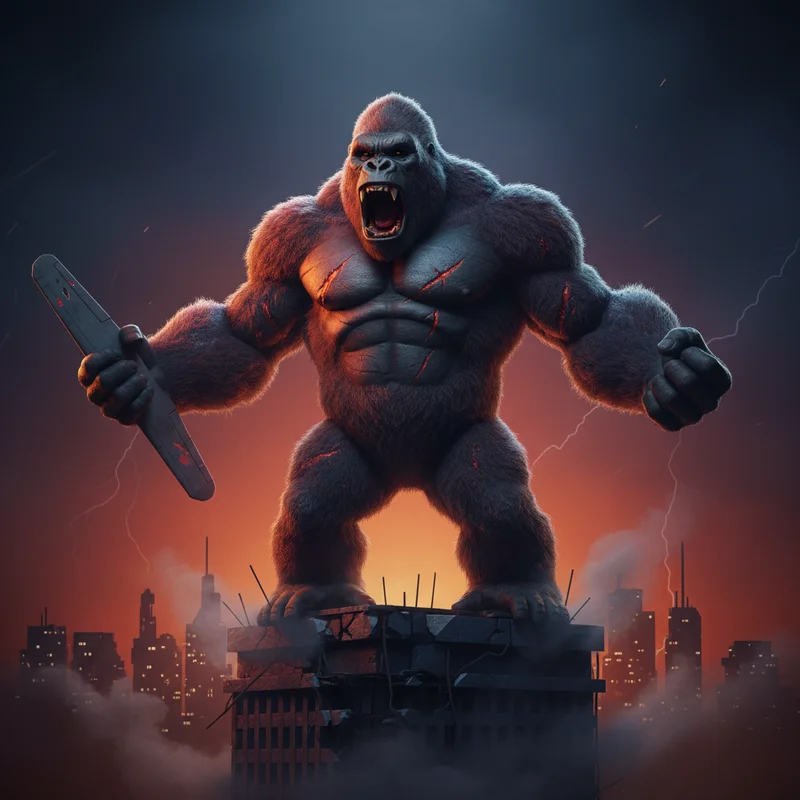
King Kong

King Kong

Giant ape with a thing for tall buildings.

VS
Social Media

Social Media

Digital platforms connecting and dividing humanity simultaneously.

Battle Analysis

Stress impact Social Media Wins
30%
70%
King Kong Social Media

King Kong

Encounters with King Kong produce acute stress responses of the highest magnitude. Survivors of Kong's various rampages—documented across multiple film iterations—exhibit symptoms consistent with severe psychological trauma: heightened cortisol levels, persistent hypervigilance, and post-traumatic intrusions. However, such encounters remain blessedly rare, confined to fictional New York and Skull Island. The stress Kong generates, whilst intense, is temporally bounded and affects a relatively small population of fictional characters.

Social Media

Social media has been clinically associated with chronic stress, anxiety, depression, and diminished well-being across numerous peer-reviewed studies. The platforms' mechanisms of intermittent reinforcement, social comparison, and algorithmic manipulation create persistent low-grade stress in billions of users. Adolescents appear particularly vulnerable, with documented increases in self-harm and suicidal ideation correlating with social media adoption. Unlike Kong's acute terror, social media's stress impact is diffuse, constant, and global in scope.

VERDICT

Social media inflicts measurable psychological harm upon billions, vastly exceeding Kong's fictional casualty count.
Media presence Social Media Wins
30%
70%
King Kong Social Media

King Kong

King Kong's media presence spans nine decades of cinema, television, literature, and video games. The character has appeared in over a dozen feature films, countless documentaries, academic publications, and artistic works. Kong has graced magazine covers, inspired musical compositions, and featured in advertising campaigns worldwide. His image has become so embedded in visual culture that it functions as a kind of universal shorthand for concepts of monstrosity, tragic romance, and the conflict between nature and civilisation.

Social Media

Social media does not merely have media presence; it has become the primary medium through which presence itself is constructed and perceived. The platforms serve simultaneously as distribution channels, content creators, and the very lens through which billions interpret reality. News organisations, governments, celebrities, and ordinary citizens alike rely upon social media for communication. The medium has effectively absorbed television, print journalism, radio, and traditional advertising into its ever-expanding maw.

VERDICT

Social media has transcended media presence to become the architecture of contemporary communication.
Global recognition Social Media Wins
30%
70%
King Kong Social Media

King Kong

King Kong enjoys remarkable global recognition that has persisted for nine decades. From the original 1933 RKO production through the 2005 Peter Jackson remake and the contemporary MonsterVerse franchise, the great ape has maintained cultural relevance across vastly different eras. His image requires no translation; the silhouette of a giant gorilla clutching a skyscraper communicates instantly across linguistic barriers. Merchandise, theme park attractions, and academic studies continue to proliferate, testament to Kong's enduring place in the human imagination.

Social Media

Social media platforms have achieved a form of global recognition unprecedented in human history. With over four billion active users worldwide, platforms such as Facebook, Instagram, TikTok, and X have penetrated virtually every nation on Earth. The terminology of social media—likes, shares, followers, viral content—has entered the lexicon of hundreds of languages. Unlike Kong, social media is not merely recognised but actively utilised by approximately half of humanity on a daily basis, representing a saturation of awareness that no fictional creation could hope to match.

VERDICT

Whilst Kong is universally recognised, social media has become universally embedded in human behaviour itself.
Entertainment value King Kong Wins
70%
30%
King Kong Social Media

King Kong

As pure entertainment, King Kong represents a masterwork of narrative construction. The original 1933 film pioneered special effects techniques, whilst subsequent iterations have continued to push the boundaries of visual storytelling. Kong's story—a creature torn from his natural environment, exploited for profit, ultimately destroyed by the very civilisation that created his legend—resonates with timeless themes of hubris, tragedy, and the beautiful destruction of the sublime. Each Kong film offers a self-contained narrative arc with clear dramatic stakes.

Social Media

Social media provides entertainment of a fundamentally different character: infinite, algorithmically personalised, and participatory. Users may scroll through an endless stream of content tailored precisely to their preferences, from educational videos to absurdist humour to live broadcasts of global events. The entertainment is not merely consumed but created by the users themselves, generating a feedback loop of unprecedented engagement. However, critics note this entertainment often proves hollow, optimised for compulsion rather than satisfaction.

VERDICT

Kong offers crafted narrative excellence, whilst social media provides merely addictive distraction.
Intimidation factor King Kong Wins
70%
30%
King Kong Social Media

King Kong

The intimidation factor of a twenty-five-foot primate cannot be understated. King Kong represents primal terror made manifest—the ancestral fear of predators writ impossibly large. His physical presence, documented across numerous films, includes the capacity to derail trains, tear apart Tyrannosaurus rex specimens, and scale the tallest structures of human civilisation. The creature embodies what scholars term the 'sublime terror' of nature unconstrained, a force against which human ingenuity seems pitifully inadequate.

Social Media

Social media's intimidation operates through subtler yet arguably more pervasive mechanisms. The platform's capacity for public humiliation, career destruction, and social ostracism creates a persistent undercurrent of anxiety in modern life. The phenomenon of 'cancellation' represents a form of social death that many find more terrifying than physical confrontation. Furthermore, the algorithmic amplification of outrage and the permanence of digital records generate a surveillance environment that would have seemed dystopian to previous generations.

VERDICT

Kong's physical terror, whilst less probable, represents an absolute and unmistakable threat to survival.
👑

The Winner Is

Social Media

42 - 58
This comparative analysis reveals a fascinating asymmetry between two forms of colossal influence. King Kong embodies the romantic tradition of the singular sublime—a discrete entity whose power, whilst magnificent, remains bounded and comprehensible. Social media, conversely, represents a new category of force altogether: distributed, invisible, and woven into the very fabric of contemporary existence. Kong can destroy buildings; social media restructures minds. Kong commands fear through physical presence; social media generates anxiety through omnipresent absence. In the calculus of influence upon human civilisation, social media emerges as the more consequential titan, having achieved what Kong could only briefly simulate: the capture and retention of global attention.
King Kong
42%
Social Media
58%

Share this battle

More Comparisons