Topic Battle

Where Everything Fights Everything

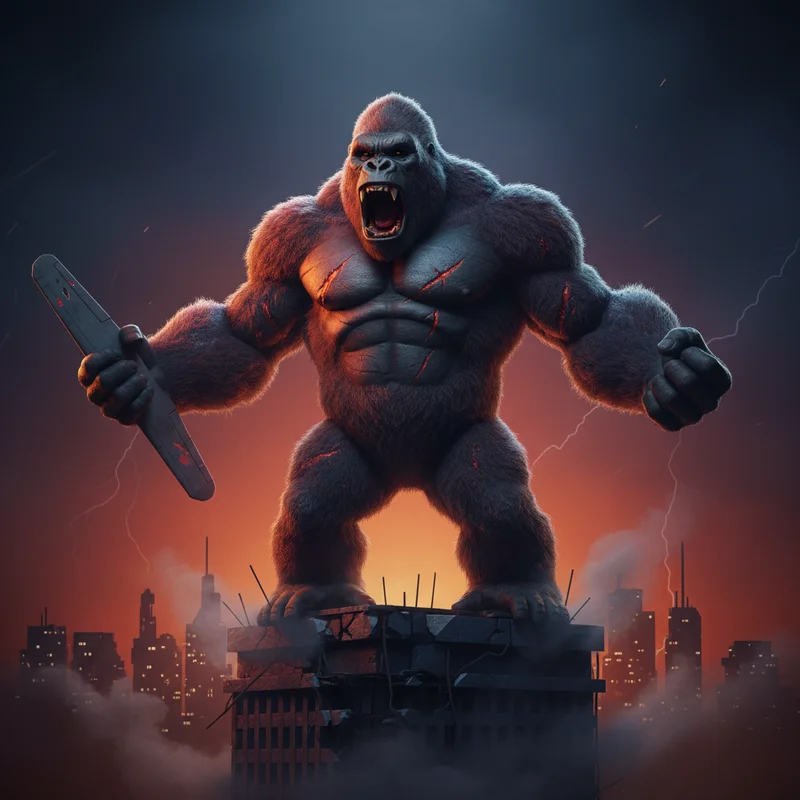
King Kong

King Kong

Giant ape with a thing for tall buildings.

VS
The Internet

The Internet

Global network of information and cat videos.

Battle Analysis

Adaptability The Internet Wins
30%
70%
King Kong The Internet

King Kong

King Kong has demonstrated remarkable adaptability within the constraints of fictional representation. He has successfully transitioned from stop-motion animation to animatronics to computer-generated imagery. His character has been reimagined across multiple cultural contexts, from American depression-era spectacle to Japanese monster cinema to modern franchise filmmaking. Kong has adapted to fight dinosaurs, giant reptiles, and mechanical doppelgangers with equal facility, suggesting considerable versatility within his narrative ecosystem.

The Internet

The Internet's adaptability defies simple characterisation, representing perhaps the most flexible system humans have ever created. From text-based bulletin boards to streaming video platforms, from desktop computers to smartphones to refrigerators, the Internet has colonised virtually every electronic device conceived. It adapts to regulatory environments, routes around censorship, and evolves protocols to meet emerging demands. Each perceived limitation spawns innovation; each attempt at control generates circumvention. It adapts not merely to survive but to encompass.

VERDICT

The Internet's capacity for continuous evolution across all domains remains unparalleled.
Media presence The Internet Wins
30%
70%
King Kong The Internet

King Kong

King Kong's media presence spans nine decades of entertainment production. He has appeared in twelve feature films, numerous television programmes, video games, comic books, and theme park attractions. His image adorns merchandise across global markets. The 2005 Peter Jackson film alone grossed over five hundred million dollars worldwide, whilst the MonsterVerse franchise has generated billions in revenue. Kong remains a bankable media property whose earning potential shows no sign of diminution.

The Internet

To speak of the Internet's media presence inverts the relationship entirely—the Internet does not appear in media; it has become the primary medium through which all other media is distributed. Streaming platforms, social networks, news organisations, and entertainment conglomerates exist within its architecture. The Internet hosts approximately two billion websites, facilitates over three hundred billion emails daily, and streams thousands of petabytes of video content hourly. It is not present in media; media is present within it.

VERDICT

The Internet subsumes all other media rather than merely appearing within them.
Symbolic value King Kong Wins
70%
30%
King Kong The Internet

King Kong

King Kong carries symbolic weight that scholars have analysed for decades. He represents nature's revenge upon industrial civilisation, the dangers of colonial exploitation, the tragedy of the captive outsider, and humanity's conflicted relationship with the sublime. His fall from the Empire State Building—beauty killing the beast—resonates as archetypal tragedy. Kong symbolises vulnerability hidden beneath apparent monstrosity, power ultimately helpless before technological modernity. His meaning has only deepened with successive cultural reinterpretations.

The Internet

The Internet's symbolic value proves more contested and ambivalent. It simultaneously represents humanity's greatest collaborative achievement and its most effective tool of surveillance and control. It symbolises democratised knowledge and rampant misinformation, global connection and profound isolation, limitless potential and addictive entrapment. The Internet's meaning remains unsettled precisely because its implications continue to unfold. It symbolises the present moment's fundamental uncertainty about technological destiny.

VERDICT

Kong's symbolic meanings have crystallised into enduring cultural significance over ninety years.
Global recognition The Internet Wins
30%
70%
King Kong The Internet

King Kong

King Kong enjoys remarkable global recognition that transcends generational and cultural boundaries. Since his cinematic debut in 1933, the great ape has been the subject of numerous remakes, sequels, and crossover events, most recently confronting Godzilla in billion-dollar franchise productions. His image—the massive primate atop a skyscraper, clutching an imperilled woman—has achieved iconographic status comparable to the most enduring symbols of Western popular culture. Survey data consistently demonstrates that Kong remains identifiable across demographics worldwide, a testament to nearly a century of sustained cultural presence.

The Internet

The Internet's recognition operates on an altogether different scale. With approximately five billion users as of recent estimates, it has achieved a penetration into human consciousness that no fictional character could match. It is not merely recognised but fundamentally relied upon—woven into the fabric of commerce, governance, education, and social interaction. The Internet does not need to be recognised; it has become the medium through which recognition itself occurs. Its ubiquity renders the question of awareness almost meaningless.

VERDICT

The Internet transcends mere recognition to become the infrastructure of modern cognition itself.
Intimidation factor King Kong Wins
70%
30%
King Kong The Internet

King Kong

The intimidation presented by King Kong operates on primal, visceral levels hardwired into human neurology. Standing at heights variously depicted between seven and thirty metres, Kong embodies ancestral fears of predation by larger creatures. His roar triggers instinctive terror responses; his musculature suggests force sufficient to destroy armoured vehicles. He represents nature's capacity for violence rendered at impossible scale—a walking reminder of humanity's physical vulnerability when stripped of technological advantage.

The Internet

The Internet's capacity for intimidation, whilst less immediate, proves considerably more insidious upon examination. It threatens not physical annihilation but something perhaps more troubling: the complete exposure of one's private existence, the destruction of reputation through viral dissemination, the manipulation of perception through algorithmic curation. Cybersecurity experts speak of existential risks to infrastructure, whilst psychologists document rising anxiety disorders linked to online interaction. The Internet intimidates through omniscience rather than omnipotence.

VERDICT

Primal terror of physical annihilation by a giant ape remains psychologically unmatched.
👑

The Winner Is

The Internet

43 - 57
This examination reveals a profound asymmetry between these two subjects that renders traditional comparison almost inadequate. King Kong excels in those domains where singular narrative focus provides advantage—intimidation, symbolic resonance, and cultural iconography refined over decades. Yet the Internet operates on a scale that transcends comparison, functioning not as a competitor to Kong but as the very environment within which Kong's continued relevance depends. The great ape's modern popularity relies entirely upon internet-distributed content, social media discussion, and streaming platform availability. In the final analysis, the Internet emerges victorious not by defeating Kong but by containing him entirely within its boundless digital territory.
King Kong
43%
The Internet
57%

Share this battle

More Comparisons