
Lego
The Lego brick possesses no raw power in any conventional sense. It cannot summon lightning, control weather patterns, or fell frost giants with a casual swing. Its power, such as it exists, derives entirely from human imagination and assembly labour. A single Lego brick, dropped from modest height onto a bare foot at three o'clock in the morning, can reduce a grown adult to vocabulary their children should not hear, but this represents transferred kinetic energy rather than inherent force.
However, Lego demonstrates a different form of power: the capacity for unlimited structural potential. Given sufficient bricks and patience, one could theoretically construct anything, from a replica of the Eiffel Tower to a functional (if somewhat painful to operate) automobile. This generative capacity represents power through possibility rather than destruction.
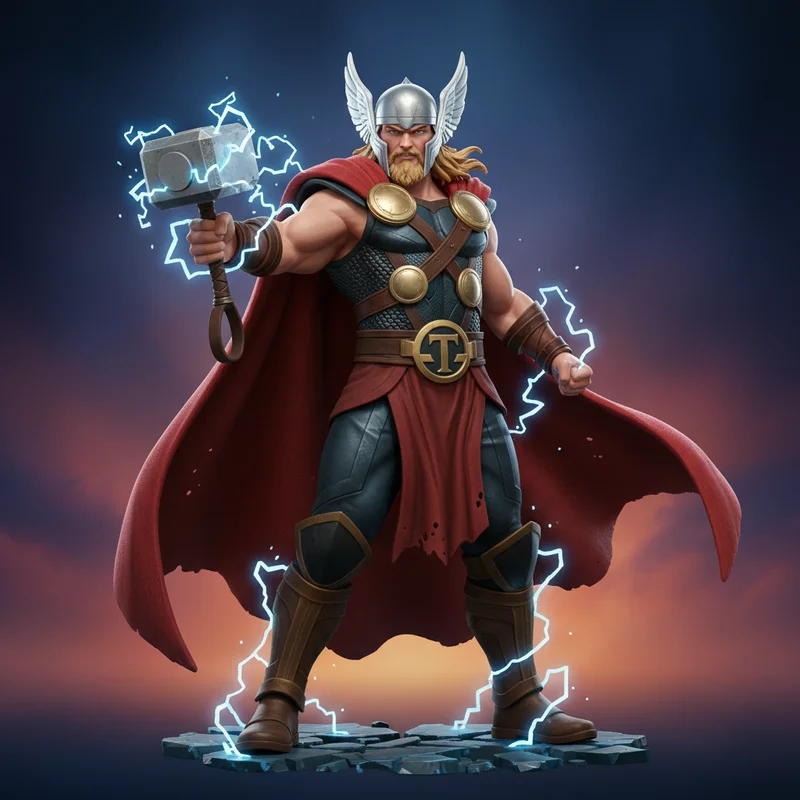
Thor
Thor Odinson represents power in its most unambiguous manifestation. As the Asgardian God of Thunder, his abilities include summoning storms across entire continents, channelling lightning through his enchanted hammer or axe, flight via rotational hammer physics that physicists prefer not to examine too closely, and near-invulnerability to most forms of damage. He has battled world-serpents, dark elves, and his own adopted sibling on numerous occasions.
Thor's raw power registers on scales that Lego's design engineers never contemplated. A single strike from Mjolnir can level buildings, whilst Stormbreaker has been shown capable of slicing through cosmic energy beams. The thunder god's strength permits lifting objects of astronomical mass and punching entities that would reduce ordinary matter to constituent atoms.