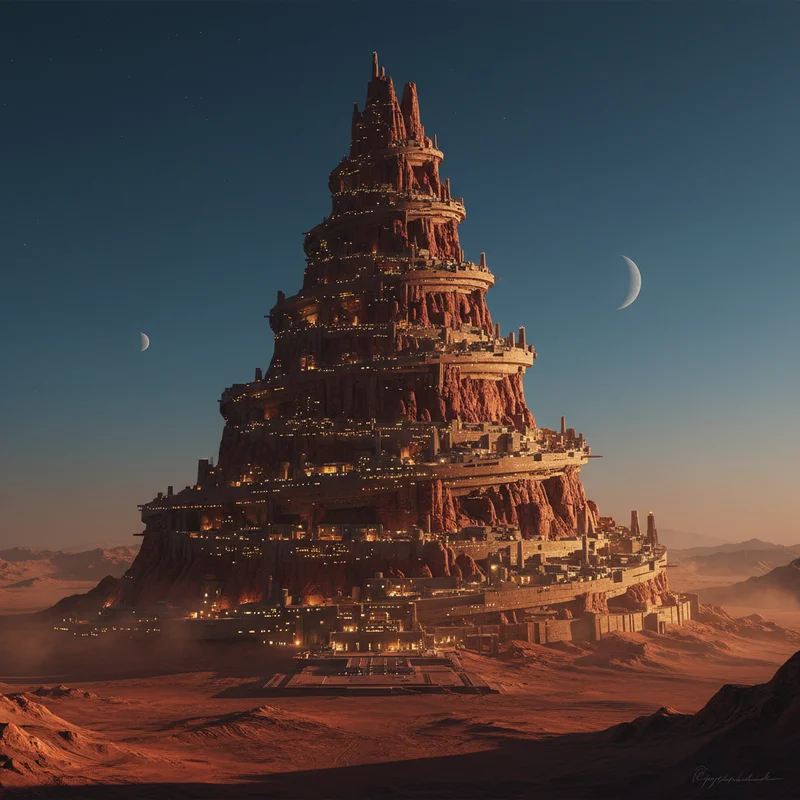

Topic Battle

Where Everything Fights Everything

Mars

Mars

Red planet and humanity's next frontier.

VS
Money

Money

Abstract concept that runs the world.

Battle Analysis

Longevity mars Wins
70%
30%
Mars Money

Mars

Mars has existed for approximately 4.6 billion years, coalescing from the same primordial disc of gas and dust that formed our entire solar system. It will continue its orbital journey for billions of years hence, outlasting not only human civilisation but likely our species entirely.

The planet's longevity is cosmologically assured. Barring collision with an interstellar object or the eventual expansion of our Sun, Mars will persist as a silent witness to epochs beyond human comprehension. It was ancient when the first life stirred on Earth and will remain after the last human thought has flickered out.

Money

Money, as a concept, emerged approximately 5,000 years ago with the development of standardised exchange systems in Mesopotamia. Its physical forms have proven remarkably ephemeral: currencies rise and collapse, empires and their coinage vanish into archaeological strata, and entire monetary systems can evaporate within single lifetimes.

Yet the concept of money demonstrates extraordinary persistence. Despite countless individual currency failures, the institution of monetary exchange has only strengthened over millennia. Money may change form from shell to coin to digit, but its fundamental function endures with no apparent expiration date.

VERDICT

Four point six billion years of existence comprehensively outpaces any human invention, regardless of money's conceptual durability.
Accessibility money Wins
30%
70%
Mars Money

Mars

Mars remains profoundly inaccessible to the vast majority of humanity. At closest approach, the planet lies 54.6 million kilometres distant, a journey requiring approximately seven months with current propulsion technology. No human has ever set foot on Martian soil; only robotic emissaries have survived the landing.

Even visual access requires specific conditions. Mars achieves naked-eye visibility only during favourable portions of its 687-day orbital period. For the average human, Mars exists primarily as an abstract concept, a dot of light occasionally visible in the night sky, forever beyond direct sensory engagement.

Money

Money achieves near-universal accessibility across human populations. From the infant receiving their first pocket money to the nonagenarian managing a pension, engagement with monetary systems spans virtually the entire human lifespan. Over 5 billion adults possess some form of bank account, with countless more participating in informal cash economies.

The accessibility extends beyond mere possession to conceptual ubiquity. Children as young as three demonstrate understanding of exchange principles, and the concept of buying and selling transcends linguistic and cultural barriers with remarkable efficiency.

VERDICT

Money is handled daily by billions; Mars has been touched only by robots, remaining 54 million kilometres from human grasp.
Global influence money Wins
30%
70%
Mars Money

Mars

Mars exerts influence primarily through cultural and scientific channels. It has inspired thousands of works of science fiction, shaped space agency budgets across multiple nations, and provided employment for countless engineers, scientists, and mission specialists. The Mars economy, including related tourism, merchandise, and media, generates billions annually.

However, this influence remains largely aspirational and indirect. The planet cannot enforce compliance, demand tribute, or restructure social hierarchies. Its influence operates through inspiration rather than compulsion, affecting primarily those already predisposed to cosmic contemplation.

Money

Money's global influence approaches the totalitarian in its comprehensiveness. No nation, culture, or community operates entirely outside its sphere. From the Swiss franc to cryptocurrency, from cowrie shells to gold bullion, some form of monetary system has governed human exchange for at least 5,000 years of recorded history.

The influence extends beyond mere transaction. Money determines access to healthcare, education, nutrition, and shelter. It shapes geopolitical alliances, drives migration patterns, and influences reproductive choices. Approximately 736 million people live in extreme poverty, their lives circumscribed by money's absence as surely as the wealthy are enabled by its presence.

VERDICT

Money structures the daily existence of every human being; Mars influences primarily through distant inspiration and occasional headline.
Motivational power money Wins
30%
70%
Mars Money

Mars

Mars possesses a singular motivational potency that transcends rational cost-benefit analysis. The planet has inspired humanity's most ambitious engineering projects, from the Viking landers of the 1970s to contemporary plans for permanent human settlement. Approximately $50 billion has been invested in Mars exploration, driven by something deeper than mere scientific curiosity.

The allure operates on a species-level instinct for expansion and survival. Mars represents backup, insurance against terrestrial extinction, and the fulfilment of evolutionary imperatives that began when our ancestors first walked upright and gazed at the stars. This motivation persists despite Mars offering nothing of immediate practical value.

Money

Money's motivational power is so pervasive as to be nearly invisible through familiarity. It drives an estimated 8 billion waking hours of human activity daily, shaping career choices, relationship decisions, and life trajectories with ruthless efficiency. The pursuit of money has launched wars, toppled governments, and motivated innovations from the wheel to the microprocessor.

Unlike Mars's abstract appeal, money provides immediate feedback loops through the dopamine response associated with acquisition. Studies demonstrate that monetary gain activates the same neural pathways as food and social bonding, suggesting that evolution has co-opted fundamental survival mechanisms for financial motivation.

VERDICT

Money motivates billions daily through neurological reward systems, whilst Mars inspires a comparatively small cohort of dreamers and engineers.
Transformative potential mars Wins
70%
30%
Mars Money

Mars

Mars offers civilisational transformation of the most profound variety. Successful colonisation would mark humanity's first permanent presence on another world, fundamentally altering our species' existential risk profile. A multi-planetary species cannot be extinguished by any single-planet catastrophe, from asteroid impact to nuclear war.

The technological developments required for Mars settlement promise terrestrial benefits in life support, recycling, energy efficiency, and sustainable living. Mars represents not merely a destination but a crucible for innovations that could transform life on Earth. The transformative potential is species-level in scope.

Money

Money has already demonstrated extraordinary transformative capacity throughout human history. It enabled the transition from barter to complex economies, facilitated the rise of civilisations, and continues to drive technological innovation through investment and incentive structures. The venture capital system alone has transformed how societies develop new technologies.

Yet money's transformative potential also carries significant limitations. It cannot create resources where none exist, solve problems that lack profitable solutions, or ensure equitable distribution of benefits. Money transforms what is possible but cannot expand the fundamental boundaries of physical reality.

VERDICT

Mars offers species-level transformation through multi-planetary existence; money, however powerful, operates within existing terrestrial constraints.
👑

The Winner Is

Money

45 - 55

This investigation reveals a fascinating tension between the immediate and pervasive versus the distant and transformative. Money dominates the present with an influence so comprehensive that fish might sooner recognise water than humans appreciate its ubiquity. It motivates, constrains, enables, and destroys with equal facility, shaping every aspect of contemporary existence.

Yet Mars represents something that money, for all its power, cannot easily replicate: a transcendent purpose beyond acquisition and exchange. The Red Planet offers humanity an exit strategy, a frontier that could ensure species survival across geological timescales. Money can fund the journey to Mars, but it cannot provide the destination.

In the final accounting, victory must be awarded to Money, with a score of 55 to 45. The margin acknowledges Mars's superiority in longevity and transformative potential whilst recognising that money's daily dominion over human existence simply cannot be matched by a world no human has ever touched. Mars may represent humanity's future, but money is humanity's present.

Mars
45%
Money
55%

Share this battle

More Comparisons