Topic Battle

Where Everything Fights Everything

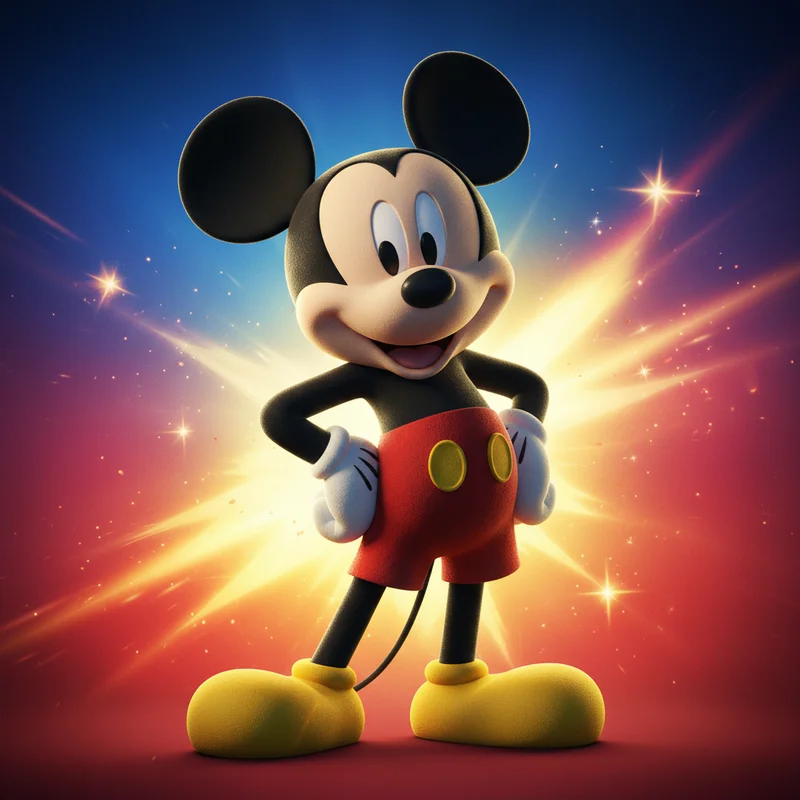
Mickey Mouse

Mickey Mouse

Disney's original mascot and corporate icon.

VS
Minecraft

Minecraft

Block-building sandbox game with infinite possibilities.

Battle Analysis

Economic magnitude Mickey Mouse Wins
70%
30%
Mickey Mouse Minecraft

Mickey Mouse

Mickey Mouse serves as the mascot for The Walt Disney Company, a corporate entity valued at approximately $170 billion, generating annual revenues exceeding $80 billion. The character's licensing revenue alone—appearing on merchandise from plush toys to luxury wristwatches—generates billions annually. Mickey's economic footprint includes theme parks (the most visited tourist attractions globally), streaming services, theatrical releases, and a cruise line.

The character's copyright extensions have literally reshaped intellectual property law, with the 'Mickey Mouse Protection Act' extending corporate copyright terms specifically to prevent the character entering public domain. Mickey Mouse arguably represents the most valuable fictional character in human history, with his silhouette trademarked across every conceivable product category.

Minecraft

Minecraft achieved commercial success of unprecedented magnitude for a video game property. With over 300 million copies sold across platforms, it holds the distinction of best-selling video game ever created. Microsoft's 2014 acquisition of Mojang Studios for $2.5 billion represented one of gaming's largest transactions, and subsequent revenue has justified this investment many times over. Annual merchandise sales exceed $100 million.

Beyond direct sales, Minecraft has spawned a creator economy employing thousands—from YouTube content producers generating millions in advertising revenue to professional server administrators earning six-figure salaries. The game's educational edition serves over 35 million students globally, representing additional revenue streams and institutional partnerships with ministries of education worldwide.

VERDICT

Disney's $170 billion valuation and $80 billion annual revenue dwarf Minecraft's substantial but smaller economic footprint.
Adaptive resilience Minecraft Wins
30%
70%
Mickey Mouse Minecraft

Mickey Mouse

Mickey Mouse has demonstrated remarkable longevity, remaining culturally relevant since his 1928 debut in Steamboat Willie. The character has successfully navigated transitions from silent film to talkies, from black-and-white to colour, from theatrical shorts to television to streaming. His design has evolved subtly—pie-cut eyes becoming solid circles, proportions shifting—whilst maintaining recognisability. He has survived the Great Depression, World War II, and the fragmentation of media attention.

However, critics note that Mickey himself has become somewhat static as a character—a corporate symbol rather than an evolving personality. His role has shifted from protagonist to mascot, with newer Disney properties carrying narrative weight whilst Mickey serves ceremonial functions.

Minecraft

Minecraft's architectural flexibility has proven its greatest adaptive asset. The game's fundamental mechanics—placing and removing blocks—remain unchanged since 2011, yet the experience continues evolving through community modification. Over 100,000 community-created modifications extend gameplay in directions the original developers never envisioned: dinosaur survival, space exploration, educational chemistry simulations.

The game successfully transitioned from PC exclusivity to console, mobile, and virtual reality platforms. Its visual style—deliberately primitive—ages gracefully where photorealistic competitors become dated. Educational institutions increasingly integrate Minecraft into curricula, ensuring generational transmission. The Minecraft: Education Edition demonstrates corporate commitment to long-term relevance beyond entertainment.

VERDICT

Minecraft's modular architecture enables infinite community-driven evolution, whilst Mickey's adaptation remains corporate-controlled and increasingly static.
Pedagogical utility Minecraft Wins
30%
70%
Mickey Mouse Minecraft

Mickey Mouse

Disney's educational initiatives through Mickey Mouse include the Disney Learning programme and various edutainment productions. The character has fronted content teaching basic literacy, numeracy, and prosocial behaviour to preschool audiences. Mickey Mouse Clubhouse incorporated problem-solving elements, whilst various book series utilise the character to encourage reading engagement. Museums occasionally partner with Disney for educational exhibitions.

However, Mickey's pedagogical application remains limited to early childhood and brand-adjacent subjects. The character cannot teach advanced mathematics, programming concepts, or scientific methodology. Educational use requires licensing agreements with a corporation notably protective of its intellectual property.

Minecraft

Minecraft has achieved institutional adoption unprecedented for a commercial video game. Over 35 million students across 115 countries utilise Minecraft: Education Edition, which includes specialised lesson plans for subjects ranging from history (reconstructing ancient civilisations) to chemistry (crafting compounds from elemental blocks) to coding (through integrated programming interfaces). The game teaches computational thinking, spatial reasoning, and collaborative problem-solving through intrinsically motivated exploration.

Peer-reviewed research demonstrates Minecraft's efficacy in teaching complex STEM concepts—students building functioning computers within the game develop genuine understanding of logic gates and binary processing. Architecture programmes, urban planning courses, and environmental science classes have all integrated Minecraft as a pedagogical tool, representing a breadth of educational application no fictional character can match.

VERDICT

Minecraft's institutional adoption across 115 countries and diverse subject integration vastly exceeds Mickey's limited early-childhood applications.
Architectural influence Minecraft Wins
30%
70%
Mickey Mouse Minecraft

Mickey Mouse

Mickey Mouse's architectural legacy manifests primarily through the Disney theme park phenomenon—a carefully orchestrated built environment spanning six resort destinations across four continents. The Cinderella Castle, standing 57.6 metres at Walt Disney World, represents perhaps the most photographed non-religious structure in the Western hemisphere. These environments demonstrate sophisticated understanding of forced perspective and crowd psychology, creating immersive spaces that have influenced shopping centre design, hospital waiting rooms, and urban planning principles worldwide.

The character's silhouette, those distinctive circular ears, has been incorporated into building designs, landscaping patterns, and even the layout of entire housing developments visible from aerial photography. Disney's architectural philosophy—the elimination of visual 'backstage' elements—has profoundly shaped modern experience design.

Minecraft

Minecraft has fundamentally revolutionised humanity's relationship with architectural possibility. Within its procedurally generated worlds, players have constructed full-scale replicas of the Palace of Versailles, King's Landing from popular fantasy literature, and functioning computational devices capable of basic arithmetic. The game has been adopted by architecture programmes at prestigious universities as a rapid prototyping tool, allowing students to explore spatial relationships before committing to physical models.

Denmark's government famously commissioned a 1:1 scale recreation of the entire nation within Minecraft, comprising over four trillion blocks. The game has democratised architectural expression, enabling millions of individuals with no formal training to engage with concepts of space, proportion, and structural engineering. Professional architects report using Minecraft for client presentations, citing its accessibility.

VERDICT

Minecraft democratises architectural creation for hundreds of millions, whilst Mickey Mouse's influence remains confined to corporate environments.
Psychological engagement Minecraft Wins
30%
70%
Mickey Mouse Minecraft

Mickey Mouse

Mickey Mouse operates through parasocial relationship mechanics—the psychological phenomenon whereby audiences develop one-sided emotional bonds with media figures. Studies in developmental psychology demonstrate that exposure to Mickey during formative years creates lasting brand loyalty, with adults reporting nostalgic emotional responses decades after initial exposure. The character's design exploits neoteny—juvenile physical features that trigger protective instincts in adult humans.

Disney's strategic deployment of Mickey across merchandise, media, and physical spaces creates what psychologists term 'environmental embedding'—the character becomes associated with positive memories, family bonding, and childhood wonder. However, this engagement remains fundamentally passive; the audience receives rather than creates.

Minecraft

Minecraft engages psychological mechanisms of flow state—that optimal experience zone identified by Mihaly Csikszentmihalyi where challenge precisely matches capability. Players report losing hours to construction projects, exhibiting the same neurological patterns observed in artists and craftspeople. The game stimulates dopaminergic reward pathways through its mining and crafting loops whilst simultaneously engaging spatial reasoning centres through three-dimensional construction challenges.

Research published in peer-reviewed journals demonstrates Minecraft's efficacy in treating anxiety disorders, with the predictable, controllable environment providing therapeutic benefit. The game demands active cognitive engagement—planning, resource management, risk assessment—rather than passive consumption, resulting in deeper psychological investment and measurable improvements in executive function.

VERDICT

Active creation in Minecraft produces documented cognitive benefits, whilst Mickey Mouse engagement remains fundamentally passive consumption.
👑

The Winner Is

46 - 54

This comprehensive examination reveals a fascinating generational transition in cultural influence. Mickey Mouse, that venerable ambassador of twentieth-century entertainment, commands undeniable economic supremacy—his corporate parent dwarfs Minecraft's creators in market capitalisation and revenue generation. The mouse represents perhaps humanity's most successful experiment in brand construction, his silhouette recognised in virtually every nation on Earth.

Yet Minecraft prevails in our analysis, securing victory across four of five assessed criteria. The game's triumph reflects a fundamental shift in how humans engage with entertainment media. Where Mickey asks us to watch, Minecraft invites us to create. Where Disney offers carefully controlled narratives, Minecraft provides infinite procedural possibility. Where the mouse remains static—a symbol rather than an experience—the blocks continue evolving through community innovation.

The pedagogical dimension proves particularly decisive. Minecraft's integration into formal education systems worldwide—teaching everything from ancient history to quantum computing concepts—represents a cultural penetration Mickey Mouse cannot match despite his longer tenure.

Mickey Mouse
46%
Minecraft
54%

Share this battle

More Comparisons