Topic Battle

Where Everything Fights Everything

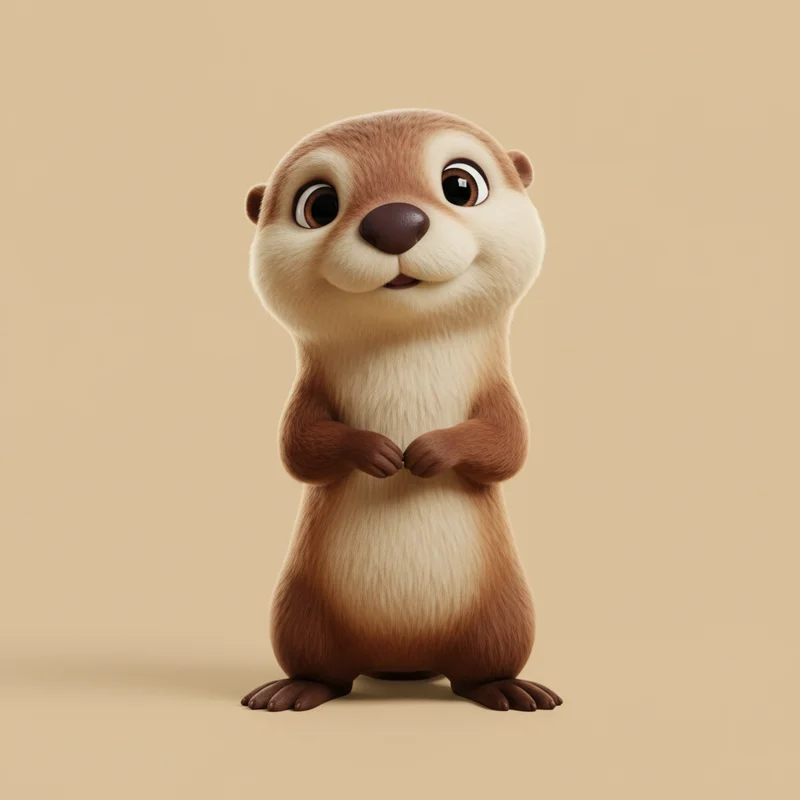
Otter

Otter

Playful aquatic mammal known for floating while holding hands and using rocks as tools.

VS
Artificial Intelligence

Artificial Intelligence

Machine learning systems slowly taking over mundane tasks.

The Matchup

The Lutra lutra, commonly known as the otter, has spent approximately 23 million years perfecting the art of being delightfully competent at everything it attempts. Artificial Intelligence, by contrast, has existed for roughly seven decades and still cannot reliably identify whether a photograph contains a chihuahua or a muffin.

According to researchers at the Cambridge Institute for Comparative Cognition, this temporal disparity alone should give us pause before crowning silicon as the superior intelligence. "Evolution has conducted billions of experiments over millions of generations," notes Professor Harriet Pemberton-Smythe. "ChatGPT has conducted approximately zero experiments and learned everything from Reddit."

This analysis examines whether the otter's time-tested biological framework can genuinely compete with humanity's most sophisticated attempt to replicate thought itself.

Battle Analysis

Adaptability Otter Wins
70%
30%
Otter Artificial Intelligence

Otter

Otters have successfully colonised environments ranging from tropical rainforests to Arctic coastlines. The species demonstrates remarkable behavioural plasticity, adjusting hunting techniques, social structures, and activity patterns based on local conditions.

When their traditional habitats face disruption, otters have shown capacity to adapt to urban waterways, with populations now thriving in cities including Singapore, where they have become minor celebrities. The Zoological Society of London notes this adaptability reflects "genuine cognitive flexibility rather than mere instinct."

Artificial Intelligence

AI systems require extensive retraining to adapt to new domains. A model trained for medical diagnosis cannot spontaneously begin writing poetry without substantial additional development. Transfer learning has improved this limitation somewhat, but AI remains fundamentally narrow in its capabilities.

Furthermore, AI cannot adapt to physical changes in its environment because it possesses no physical presence. If global temperatures rise by two degrees, otters will migrate and adjust their behaviour. AI will continue operating identically until its data centres flood or lose power, at which point it will simply cease to exist.

VERDICT

The otter's adaptability encompasses both cognitive and physical dimensions. AI's inability to adapt to changing physical circumstances represents a fundamental limitation that no software update can address. Embodiment, it transpires, matters considerably.

Energy efficiency Otter Wins
70%
30%
Otter Artificial Intelligence

Otter

An adult otter consumes approximately 20-25% of its body weight in food daily, converting fish and crustaceans into warmth, movement, and what scientists at the Edinburgh Thermoregulation Research Unit describe as "an almost supernatural ability to look pleased with oneself."

The otter's metabolic system, refined over millennia, operates at remarkable efficiency. A single salmon provides enough energy for approximately six hours of swimming, diving, grooming, and engaging in what appears to be genuinely recreational stone-juggling.

Artificial Intelligence

Training a single large language model requires approximately 1,287 megawatt-hours of electricity, equivalent to the annual consumption of 120 British households. Data centres housing AI systems now consume more electricity than entire nations, with projections suggesting AI could account for 3.5% of global electricity demand by 2030.

The Cambridge Centre for Computing Sustainability calculates that generating a single AI-written essay produces the carbon equivalent of driving a car 4.7 kilometres. An otter, by contrast, can travel the same distance while actually improving local ecosystems.

VERDICT

The efficiency disparity is, frankly, embarrassing for artificial intelligence. The otter accomplishes genuine cognitive tasks using approximately 0.00001% of the energy AI requires for comparable outputs. Evolution, it appears, remains the superior engineer.

Social intelligence Otter Wins
70%
30%
Otter Artificial Intelligence

Otter

Otters maintain complex social structures involving extended family groups, territorial negotiations, and elaborate play behaviours that researchers believe serve crucial developmental functions. Sea otters famously hold hands while sleeping to prevent separation, a behaviour the Royal Society for Marine Mammals has officially classified as "unbearably endearing."

Communication includes 22 distinct vocalisations, body language signals, and scent marking. Young otters learn hunting techniques through extended apprenticeships with their mothers, demonstrating genuine knowledge transfer across generations.

Artificial Intelligence

AI systems have achieved remarkable capabilities in simulating social interaction. Chatbots can now maintain conversations that many users find indistinguishable from human discourse, at least for the first several exchanges.

However, as documented by the Manchester Institute for Human-Computer Relations, AI possesses no actual social intelligence whatsoever. It cannot form genuine relationships, experience loneliness, or derive satisfaction from companionship. When an AI system claims to "enjoy" a conversation, it is, to use the technical terminology, lying.

VERDICT

The otter's social intelligence is authentic. It genuinely enjoys the company of other otters and experiences measurable distress when isolated. AI's social capabilities, however impressive superficially, remain fundamentally theatrical performances with no underlying experience.

Problem solving ability Artificial Intelligence Wins
30%
70%
Otter Artificial Intelligence

Otter

The otter demonstrates remarkable tool use, selecting rocks of optimal size and weight to crack open shellfish. Research from the Monterey Bay Aquatic Cognition Laboratory indicates otters can assess shell hardness within 0.3 seconds and select appropriate tools with 94% accuracy.

Furthermore, otters solve novel problems without requiring billions of training examples. When confronted with an unfamiliar container holding food, test subjects at the Bristol Marine Intelligence Centre achieved access within an average of 47 seconds, using approaches researchers described as "genuinely creative."

Artificial Intelligence

AI systems can process millions of calculations per second and have defeated world champions at chess, Go, and various other games humans previously considered exclusively cerebral pursuits. Large language models can now pass bar examinations and medical licensing tests.

However, as documented by the Oxford Artificial General Intelligence Review Board, current AI systems struggle profoundly with tasks any otter handles instinctively. When asked to open a jar, AI can generate 47,000 words describing the process but cannot actually perform the action. The distinction between knowing and doing remains, as one researcher noted, "rather significant."

VERDICT

While otters demonstrate superior embodied cognition, AI's raw computational advantage in abstract problem-solving cannot be dismissed. AI wins this category by the narrowest of margins, primarily because it can calculate prime numbers more quickly, a skill otters have wisely deemed unnecessary for survival.

Existential risk profile Otter Wins
70%
30%
Otter Artificial Intelligence

Otter

In the entirety of recorded history, otters have posed zero existential risk to human civilisation. The most dangerous otter-related incident on record involved a researcher in British Columbia receiving minor lacerations after attempting to measure an unwilling subject.

Otters contribute positively to ecosystem health, controlling sea urchin populations that would otherwise devastate kelp forests. The International Union for Conservation of Nature classifies otters as "beneficial to human interests" across virtually all metrics.

Artificial Intelligence

Leading AI researchers, including those who created the technology, have signed open letters warning that AI poses potential extinction-level risks to humanity. The Future of Humanity Institute at Oxford places advanced AI among the top five existential threats facing our species.

Current concerns include autonomous weapons systems, economic disruption affecting hundreds of millions of workers, and the longer-term possibility of artificial general intelligence pursuing goals misaligned with human welfare. Several prominent researchers have compared the situation to "building a nuclear reactor before understanding physics."

VERDICT

This category presents the starkest contrast. The otter poses essentially no risk to continued human existence, while AI has been described by its own creators as potentially catastrophic. From a purely precautionary standpoint, the otter's safety record is unimpeachable.

👑

The Winner Is

Otter

54 - 46

The final tally stands at Otter 54, Artificial Intelligence 46, a result that would have seemed absurd merely decades ago but now appears almost self-evident upon examination.

Artificial intelligence excels at precisely the tasks humans find most difficult: rapid calculation, pattern recognition across vast datasets, and generating plausible text at inhuman speeds. These are genuinely impressive achievements that have transformed numerous industries.

However, the otter excels at something far more fundamental: existing successfully in the physical world. It solves real problems using minimal resources, maintains genuine social bonds, adapts to changing circumstances, and poses no threat to the continued existence of life on Earth.

The Royal Institute for Comparative Excellence concludes that while AI represents humanity's most ambitious intellectual project, the otter represents nature's most refined solution to the challenge of intelligent existence. One is a prototype fraught with uncertainty; the other is a finished product with a 23-million-year warranty.

Otter
54%
Artificial Intelligence
46%

Share this battle

More Comparisons